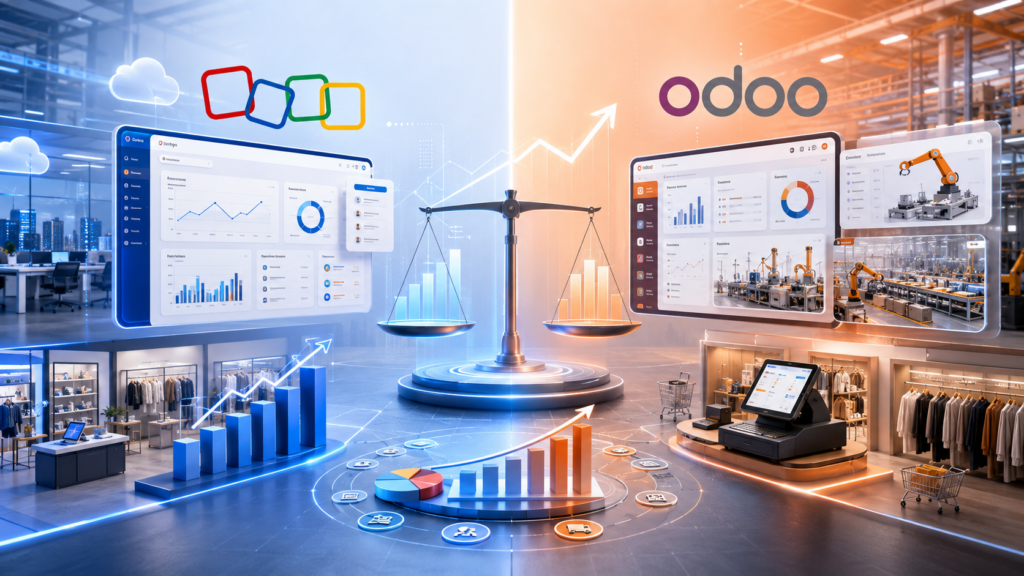
Choosing between Zoho and Odoo in 2026 is not a question of which platform is better overall. It is a question of which one fits your operations. Both are serious platforms with large user bases, active development cycles, and real-world ROI data behind them. But they are built on different assumptions about what businesses need, and those assumptions matter when your money is on the line.
This comparison focuses on manufacturing and retail because those two sectors expose the sharpest differences between the two platforms. If you run a service business or a small SaaS company, the decision is easier. If you move physical goods, manage production lines, or run inventory across multiple locations, you need to read this carefully.
What Each Platform Is Actually Built For
Zoho is a cloud-based suite of over 50 business applications. Its strength is breadth. You get CRM, accounting, HR, marketing automation, inventory, and customer support in one subscription. The integration between these tools is native, so data flows across departments without manual exports. For retail businesses that need fast setup, clean dashboards, and strong customer-facing workflows, Zoho One delivers a lot out of the box.
Odoo is an open-source ERP built on a modular architecture. Each function (sales, inventory, manufacturing, accounting, HR) is a separate module that integrates deeply with the others. Because the codebase is open, Odoo Partners can customize it at a level Zoho does not allow. That flexibility is what draws manufacturers to it. You can reshape workflows, build custom reports, and connect third-party systems without workarounds.
The fundamental difference: Zoho gives you a fast, polished, opinionated suite. Odoo gives you a flexible, customizable system that rewards investment in configuration.
Manufacturing: Where Odoo Has the Stronger Case
Manufacturing is where the gap between these two platforms becomes most obvious.
Odoo’s Manufacturing module (MRP) handles the full production lifecycle from one system. You get multi-level Bills of Materials, work order routing, real-time shop floor tracking, quality control checkpoints, equipment maintenance scheduling, and finite-capacity production planning. A confirmed sales order can automatically trigger a manufacturing order, which then checks raw material availability and flags purchase requirements. That chain of automation is native, not bolted on.
Zoho One includes Zoho Inventory and allows custom app building through Zoho Creator, but it lacks a true MRP engine. You cannot natively handle multi-level BOMs, shop floor work orders, or production routing inside Zoho’s standard suite. Manufacturers exploring Zoho typically end up using workarounds through Zoho Creator or relying on third-party integrations to fill those gaps.
A 2026 analysis of mid-size manufacturing businesses found that Odoo users reported 22% higher ROI compared to those on Zoho ERP setups, largely because Odoo handles complex operational workflows without requiring workarounds that add cost and maintenance overhead.
For manufacturers specifically, the ROI case for Odoo rests on four things:
Production accuracy. Odoo ties purchasing, inventory, and production together in real time. When stock runs low, the system flags it before it stops a production run.
Shop floor visibility. Work orders show operators exactly what to do at each step. Managers see production status in real time without chasing down floor supervisors.
Cost tracking. Odoo tracks actual production costs against standard costs at the component level. You see exactly where variances occur.
Maintenance integration. The Maintenance module connects directly to manufacturing orders. Preventive maintenance schedules run automatically based on machine usage, not just a calendar.
If you run discrete manufacturing, process manufacturing, or engineer-to-order production, Odoo is the stronger platform.
Retail: Where Zoho Closes the Gap
Retail is a different story. The operational demands of retail lean heavily on customer data, sales pipeline management, omnichannel inventory visibility, and marketing automation. These are areas where Zoho excels.
Zoho One gives retailers Zoho CRM, Zoho Inventory, Zoho Commerce, Zoho Campaigns, Zoho Desk, and Zoho Analytics in a single subscription. The AI engine Zia handles deal scoring, inventory anomaly detection, financial reconciliation, and customer sentiment analysis. A UAE-based retail chain reported a 70% reduction in manual finance work after switching to Zoho, citing Zia’s auto-reconciliation and predictive inventory features as the primary drivers.
Odoo also handles retail well, particularly for businesses with complex inventory requirements across multiple warehouse locations. Its point-of-sale module, ecommerce storefront, and inventory management are tightly integrated. If your retail operation sits inside a broader business that also does wholesale, distribution, or light manufacturing, Odoo’s unified architecture is hard to beat.
The honest split for retail looks like this:
Zoho fits better when your retail business is customer-relationship-heavy, has a straightforward supply chain, and needs fast time-to-value. Think specialty retail, e-commerce, or service-adjacent businesses where CRM and marketing automation drive most of the revenue.
Odoo fits better when your retail operation has complex inventory logic, multi-location stock management, supplier integrations, or when it connects to a distribution or manufacturing function in the same business.
Pricing: What You Actually Pay
Both platforms use per-user subscription pricing, but the structure is different enough to affect your ROI calculation.
Zoho One’s All-Employee plan costs approximately $37 per user per month when billed annually. The catch is that you must license every employee on your payroll, not just software users. For companies with large floor workforces, this requirement pushes total cost up significantly. The Flexible User plan removes that requirement but costs around $90 per user per month.
Odoo’s Standard plan runs approximately $31 per user per month (billed annually, USA pricing). The Custom (Enterprise) plan, which includes Odoo Studio, multi-company support, and external API access, starts around $46 per user per month at standard rates. Regional pricing varies significantly; businesses in the Middle East pay considerably less.
Where both platforms get more expensive is implementation. Odoo customization projects range from a few thousand dollars for basic setups to well over $50,000 for complex manufacturing deployments. Zoho’s implementation costs are generally lower because there is less custom development involved, but third-party integrations for manufacturing functions add cost.
For a 20-user manufacturing company:
Zoho One (All-Employee, annual): approximately $740 per month in licensing. Add implementation at $5,000 to $20,000. Ongoing cost is predictable and low.
Odoo Enterprise (Standard, annual, USA): approximately $620 per month in licensing for 20 users. Add implementation at $10,000 to $40,000 depending on customization depth. Long-term operational cost can be lower if the customization reduces manual work significantly.
The ROI advantage from Odoo typically materializes after 12 to 18 months when the efficiency gains from a well-implemented manufacturing system outpace the higher initial investment.
Implementation Time and Complexity
Zoho deploys faster. Most SMB implementations of Zoho One are live within 4 to 12 weeks. The platform is designed for self-service configuration, and most standard workflows require no developer involvement. For retail businesses that need to move quickly, this matters.
Odoo takes longer, particularly when manufacturing modules are involved. A standard Odoo implementation for a 15 to 30 user manufacturing company typically runs 3 to 6 months. Customization work extends that timeline. The tradeoff is that a properly implemented Odoo system requires fewer manual interventions over time because workflows are built to match exactly how your business operates.
The risk with fast Zoho implementations is that businesses sometimes fit their processes around the software instead of the other way around. The risk with longer Odoo implementations is scope creep and budget overrun. Both risks are manageable with the right implementation partner.
Scalability Over Time
Odoo generally has more headroom for scaling operations, especially when those operations grow in complexity. Adding manufacturing plants, new product lines, multiple entities, or complex compliance requirements is more straightforward in Odoo because the architecture is designed for it. Modular pricing means you activate what you need as you need it.
Zoho scales well for businesses that grow in volume but not necessarily in operational complexity. Adding more users and more customer data is easy. Adding manufacturing workflows, advanced warehouse logic, or multi-company structures typically requires moving beyond Zoho’s standard offering.
A useful test: if your growth plan involves opening a new retail location or adding more salespeople, Zoho handles that smoothly. If your growth plan involves adding a production facility, managing contract manufacturing, or integrating IoT devices on a shop floor, Odoo is the more sustainable choice.
Which Platform Delivers Higher ROI in 2026?
For manufacturing: Odoo.
The MRP capabilities, shop floor management, production cost tracking, and maintenance integration give manufacturers tools that Zoho One does not replicate without significant custom development. Odoo users in manufacturing report measurably better operational efficiency, and the long-term total cost of ownership is competitive once the system is properly implemented.
For retail: it depends on your supply chain complexity.
If your retail business has straightforward inventory and relies heavily on customer relationships, marketing campaigns, and fast reporting, Zoho delivers faster ROI with lower implementation cost. The platform is mature, the AI features are practical rather than theoretical, and the licensing model is predictable for most retail team sizes.
If your retail business manages multi-location inventory, deals with complex supplier relationships, or operates alongside a distribution or light manufacturing function, Odoo’s integrated architecture gives you better long-term control without the workarounds.
The businesses that get the worst ROI from either platform are the ones that choose based on price alone. Implementation fit matters more than the licensing fee. A poorly configured Odoo system is expensive. A Zoho setup with manufacturing gaps is a problem you pay for in manual workarounds every month.
Before committing to either platform, map your operational workflows in detail, identify your highest-cost manual processes, and test whether the platform you prefer can handle them without custom development. That exercise tells you more about ROI than any pricing comparison will.
BoyangCS specializes in Odoo ERP implementation and partnership services across Hong Kong and Malaysia. If you are evaluating Odoo for your manufacturing or retail operation, speak with our team about your specific requirements before making a decision.
If you are based in the Greater Bay Area or Hong Kong, our team provides Odoo ERP implementation in Hong Kong with HKFRS compliance and local support.