Odoo ERP for Manufacturing Companies in China: Complete Guide (2026)
Author: Daisy Liu, Certified Odoo Consultant | Boyang Technology Last updated: April 2026 Reading time: 12 minutes
Running a manufacturing business in China means managing complexity that most ERP systems are simply not designed for , multi-site production, local compliance requirements, supplier networks spread across provinces, and customers expecting real-time order visibility. Odoo ERP addresses all of these challenges within a single, integrated platform that works as well in Shenzhen as it does in Shanghai or Guangzhou.
This guide explains why Odoo has become one of the leading ERP choices for manufacturing companies in China, what specific features matter most for Chinese manufacturers, and how it compares to traditional Chinese ERP software
What is Odoo?
Odoo is an open-source suite of 80+ integrated business management applications, available in 30+ languages including Simplified Chinese. Unlike traditional ERP systems that require expensive licences and lengthy deployments, Odoo’s modular design lets manufacturers start with the modules they need today and add more as their business grows.
Originally developed in Belgium, Odoo now serves over 12 million users across 180+ countries. In China, it is available through official Odoo Partners , certified implementation specialists who provide local deployment, Chinese language support, and ongoing maintenance. Boyang is an official Odoo Partner in China.
Odoo is available in two editions:
- Community Edition: Free and open-source. Suitable for small manufacturers with basic requirements and in-house technical capability.
- Enterprise Edition: Starts at $24.90/user/month (cloud). Includes advanced manufacturing modules, priority support, and regular updates.
You can sign up for a free trial or request a product demo to see the system in action before committing.
Why Odoo works specifically for manufacturing in China
Chinese manufacturers face a distinct set of operational requirements that generic ERP systems often fail to address. Odoo’s combination of open-source flexibility and localisation support makes it well-suited to this environment.
Chinese compliance and localisation
Odoo supports the specific requirements that Chinese manufacturing businesses must meet:
- Fapiao (增值税发票) compliance: Odoo’s accounting module handles Chinese VAT invoicing requirements, including electronic Fapiao generation compatible with the Golden Tax system (金税系统).
- Simplified Chinese interface: The full Odoo interface is available in Simplified Chinese, reducing training time for factory floor and administrative staff.
- Chinese currency and banking: RMB (CNY) is fully supported across all financial modules. Local bank formats for payment processing are configurable.
- WeChat and Alipay integration: Odoo can integrate with WeChat Pay and Alipay for customer-facing payment flows, which is essential for manufacturers selling through Chinese B2B or B2C channels.
- Local data residency: Odoo can be deployed on-premise or on Chinese cloud infrastructure (Alibaba Cloud, Tencent Cloud), keeping data within China’s regulatory boundaries , an important consideration given data localisation requirements.
This level of localisation is one reason manufacturers in China increasingly choose Odoo over globally-focused ERPs that treat Chinese compliance as an afterthought.
Odoo manufacturing features: what matters most
1. Integration of multiple business processes
Manufacturing involves interconnected operations that must stay in sync. With Odoo, production, procurement, inventory, quality control, and finance are all managed within one platform , no data silos, no manual re-entry between systems.
This integration covers sales order management, production scheduling, inventory allocation, financial posting, and HR , all updating in real time. For a factory managing 500+ SKUs across multiple production lines, this kind of visibility is transformative.
2. Bill of Materials (BOM)
Managing a Bill of Materials accurately is the foundation of cost-controlled manufacturing. Odoo’s BOM module supports:
- Multi-level BOMs: Manage finished goods, sub-assemblies, and raw materials in a single structured view
- BOM variants: Handle product variations (size, colour, specification) without duplicating your entire BOM structure
- Cost calculations: Automatically roll up material, labour, and overhead costs per production order based on your BOM
- Version control: Track BOM changes over time so you always know which version was used in any given production run
For a typical Chinese manufacturer producing customised goods for export, the ability to manage multi-level BOMs with accurate cost roll-ups significantly reduces production cost variance.
3. Raw material procurement
Odoo’s procurement module connects directly to your BOM and production schedule. When a manufacturing order is confirmed, Odoo automatically checks inventory levels and generates purchase requests for shortfalls , with suggested suppliers based on your preferred vendor list and historical pricing.
Supplier profiles store contact details, lead times, pricing tiers, and performance history. For manufacturers working with dozens of component suppliers across China, this vendor management capability reduces the administrative burden of procurement significantly.
4. Inventory management across multiple warehouses
Odoo provides real-time inventory tracking across multiple warehouse locations , whether you operate a single factory in Dongguan or a network of facilities across Guangdong province. Key capabilities include:
- Lot and serial number tracking for quality traceability
- Automated reorder rules based on minimum stock thresholds
- Putaway strategies to optimise warehouse layout
- Barcode scanning support for goods receipt and dispatch
Manufacturers exporting internationally also benefit from Odoo’s landed cost calculation, which allocates shipping, customs, and handling costs accurately to inventory valuations.
5. Quality control
Product quality is non-negotiable for manufacturers supplying both domestic and export markets. Odoo’s quality module lets you define control points at any stage of production:
- Incoming goods inspection (raw materials from suppliers)
- In-process quality checks at specific manufacturing operations
- Final product inspection before goods are released to the warehouse
Each quality check generates a record with pass/fail status, inspector name, and timestamp , creating a complete audit trail that supports ISO certification and customer audits.
6. Marketing and sales alignment
Manufacturing businesses lose revenue when production and sales operate without shared data. Odoo connects CRM, sales order management, and production planning so that sales forecasts directly inform production schedules.
Built-in tools include email marketing, SMS campaigns, and website integration. For manufacturers with direct-to-business customers, the CRM module tracks opportunities, quotes, and order history in one place , giving your sales team visibility into production status when customers ask for updates.
7. Product variants
Chinese manufacturers frequently produce the same base product in multiple configurations , different sizes, materials, colours, or specifications for different customers. Odoo’s product variants system handles this without multiplying your product catalogue.
A single product template with defined variant attributes (e.g., Size: S/M/L/XL, Colour: Red/Blue/Black) generates individual variant records automatically. Inventory, pricing, and BOMs can be configured per variant, keeping your data clean without manual duplication.
8. Maintenance management
Unplanned equipment downtime is one of the most costly disruptions a manufacturer can face. Odoo’s maintenance module supports:
- Preventive maintenance scheduling: Set calendar-based or usage-based maintenance intervals for each machine
- Corrective maintenance requests: Shop floor staff can log equipment issues directly in Odoo, triggering a maintenance work order
- Equipment health tracking: Monitor mean time between failures (MTBF) and mean time to repair (MTTR) per asset
For manufacturers with high-value CNC machinery, injection moulding equipment, or assembly line tooling, this module pays for itself in reduced unplanned downtime.
9. Product Lifecycle Management (PLM)
From initial design through engineering change orders to end-of-life, Odoo PLM keeps every department aligned on the current approved version of a product.
Engineers submit change requests, which go through a configurable approval workflow before updating the master BOM and routing. Every version is archived, so you can always retrieve the exact specification used for any historical production batch.
10. Reporting and analytics
Odoo’s reporting tools give management real-time visibility into the metrics that drive manufacturing performance:
- Production efficiency (actual vs. planned hours)
- Material variance (actual vs. standard costs)
- Quality rejection rates by product and supplier
- On-time delivery performance
- Inventory turnover by product category
Dashboards are configurable per user role , a production manager sees shop floor KPIs, while the CFO sees financial performance summaries , without needing custom development.
Odoo for stage props manufacturing in China
China is one of the world’s leading producers of stage props, theatrical equipment, and event production materials, supplying markets across Asia, Europe, and North America. Stage props manufacturers face specific ERP challenges:
- Highly customised, low-volume production: Each order may involve unique specifications, custom materials, and one-off BOMs
- Multi-material assemblies: A single stage prop may combine timber, metal fabrication, electronics, and soft goods , each sourced differently
- Short lead times: Event industry clients often require rapid turnaround
- Quality documentation: Export shipments require material certificates and compliance documentation
Odoo handles all of these requirements within its standard manufacturing modules. The engineer-to-order workflow , where a custom BOM is created per sales order , is directly supported. The PLM module manages design approvals, and the quality module generates the inspection records needed for export documentation.
Chinese stage props manufacturers looking for an ERP that handles custom production without expensive customisation should evaluate Odoo as a priority.
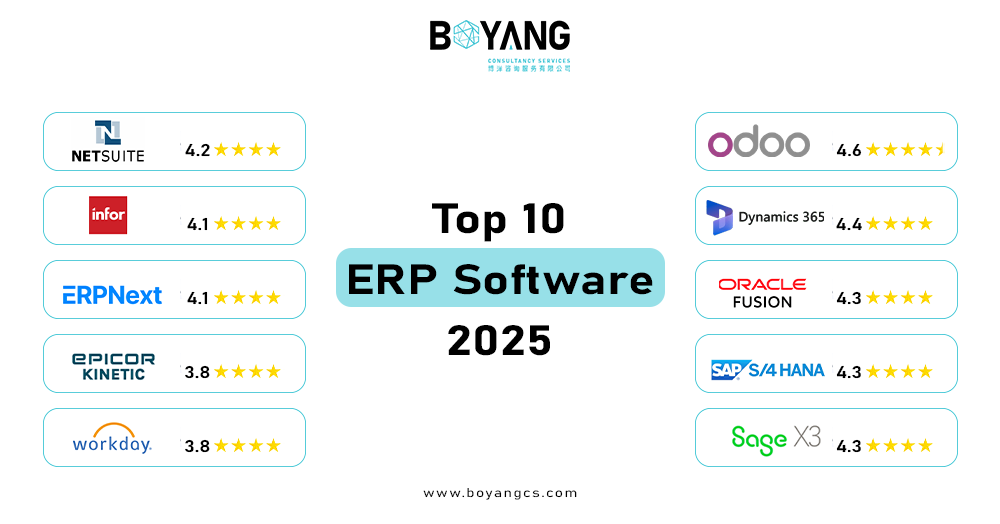
Odoo vs Chinese ERP software: an honest comparison
Manufacturers in China evaluating ERP options typically compare Odoo against local alternatives like Kingdee (金蝶), UFIDA (用友), or Inspur (浪潮).
| Criteria | Odoo | Kingdee / UFIDA |
| Pricing model | Per-user SaaS or open-source | Typically licence + annual maintenance |
| International operations | Strong (180+ countries, multi-currency) | Primarily China-focused |
| Manufacturing modules | Comprehensive (BOM, PLM, MES integration) | Varies by edition |
| Open-source flexibility | Full source code access | Proprietary |
| Global talent pool | Large (worldwide Odoo community) | Primarily China-based |
| Chinese compliance | Supported via localisation | Native |
| Implementation time | Typically 2–6 months | Similar range |
For manufacturers operating exclusively within China with no export ambitions, Kingdee or UFIDA may offer deeper local compliance integration out of the box. For manufacturers with international customers, export operations, or multi-currency requirements, Odoo’s global architecture is a significant advantage.
Odoo vs SAP for Chinese manufacturers
SAP remains the enterprise standard for large multinational manufacturers, but its complexity and cost put it out of reach for most Chinese SMEs and mid-market manufacturers. Key differences:
- Implementation cost: SAP S/4HANA implementations in China typically require 12–24 months and budgets starting from several million RMB. Odoo implementations for comparable scope run 3–6 months at a fraction of the cost.
- Flexibility: Odoo’s open-source architecture allows local partners to customise the system for specific industry needs. SAP customisation requires certified ABAP developers and carries higher long-term maintenance costs.
- User accessibility: Odoo’s interface is designed to be intuitive for non-technical users. SAP requires more extensive training.
For large multinationals with complex global supply chains and unlimited IT budgets, SAP remains a viable choice. For Chinese manufacturers of all sizes looking for a scalable, cost-effective ERP, Odoo is the stronger option.
Benefits of Odoo for manufacturing businesses in China
Affordable and scalable: Odoo’s modular pricing means manufacturers pay only for what they use. A small factory can start with Manufacturing, Inventory, and Accounting for a manageable monthly cost, then add CRM, E-commerce, or HR as the business grows.
Fast deployment: A standard Odoo manufacturing implementation in China typically runs 2–4 months from kickoff to go-live , significantly faster than tier-1 ERP alternatives.
Open-source security: Odoo’s source code is publicly available and reviewed by a global developer community. Security updates are released regularly. On-premise deployment keeps sensitive production data within your own infrastructure.
Chinese language and compliance: Full Simplified Chinese interface, Fapiao support, RMB accounting, and local payment integration mean Odoo works natively within the Chinese business environment.
No dependency on blocked platforms: Unlike some international ERP systems that rely on Google Cloud, AWS, or other platforms with access limitations in mainland China, Odoo can be deployed on local infrastructure with no dependency on internationally-blocked services.
Global community support: With over 12 million users worldwide and a large open-source community, Odoo users benefit from continuous feature development, a wide library of third-party modules, and a growing ecosystem of certified partners.
Getting started with Odoo in China
Working with a certified Odoo Partner in China is the most reliable path to a successful implementation. A local partner brings:
- Knowledge of Chinese regulatory requirements (tax, labour, export documentation)
- Simplified Chinese language configuration and training
- Local support in your time zone
- Experience with China-specific integrations (WeChat, Alipay, Alibaba ecosystem)
Boyang is an official Odoo Partner in China. We have implemented Odoo for manufacturers across Guangdong, Zhejiang, and Jiangsu provinces, covering electronics assembly, stage props production, furniture manufacturing, and consumer goods.
Request a free consultation or product demo to discuss your specific requirements.
FAQs about Odoo ERP for manufacturing companies in China
What makes Odoo ERP ideal for manufacturing companies in China?
Odoo integrates production, inventory, quality control, and financial management in one platform with full Simplified Chinese support. It handles Chinese VAT (Fapiao), local currency, and can be deployed on Chinese cloud infrastructure , making it practically suitable for mainland operations while offering international-grade manufacturing capabilities.
Is Odoo a Chinese company?
No. Odoo is an open-source ERP platform originally developed in Belgium and headquartered in Louvain-la-Neuve, Belgium. In China, it is implemented and supported by certified Odoo Partners such as Boyang, who provide localisation, customisation, and ongoing support.
How does Odoo handle Chinese tax and compliance requirements?
Odoo supports Fapiao (增值税发票) generation compatible with China’s Golden Tax system, RMB accounting, and Chinese payroll compliance. Local Odoo partners can configure additional compliance requirements specific to your industry and province.
What are the main Odoo manufacturing features?
Key features include Bill of Materials (BOM) with multi-level support, production order management, material requirements planning (MRP), quality control at production stages, preventive maintenance scheduling, product lifecycle management (PLM), and real-time inventory tracking.
Can Odoo be customised for stage props or theatrical fabrication manufacturers in China?
Yes. Odoo’s engineer-to-order workflow is well-suited to stage props manufacturing, where each order involves a custom BOM, unique material mix, and specific quality documentation for export. The open-source architecture allows customisation without replacing the core system.
How does Odoo compare with Kingdee or UFIDA?
Odoo offers stronger international capabilities (multi-currency, multi-language, global supply chain), an open-source architecture that allows deep customisation, and a larger global talent pool. Kingdee and UFIDA offer deeper native Chinese compliance in some areas. For export-oriented manufacturers, Odoo is typically the stronger choice.
What are the advantages of Odoo over SAP or Oracle for Chinese manufacturers?
Odoo implementations cost and deploy significantly faster than SAP or Oracle. The open-source model eliminates per-module licence fees, and Chinese Odoo partners can customise the system for local requirements without the ABAP or Oracle Forms expertise that SAP and Oracle customisation requires.
Can Odoo integrate with WeChat and Alipay?
Yes. Odoo supports WeChat Pay and Alipay integrations for payment processing. WeChat also integrates with Odoo’s CRM and marketing modules for customer communication workflows.
Does Odoo work on Chinese cloud platforms?
Yes. Odoo can be deployed on Alibaba Cloud (阿里云), Tencent Cloud (腾讯云), or Huawei Cloud , keeping your business data within mainland China’s regulatory environment and avoiding dependency on internationally-blocked services.
Is Odoo suitable for both small and large manufacturers in China?
Yes. Small manufacturers can start with a minimal module set (Manufacturing, Inventory, Accounting) and add capabilities over time. Large multi-site manufacturers can run complex multi-plant production, multi-entity financials, and global supply chain management within the same platform.
Does Odoo support Simplified Chinese language?
Yes. The full Odoo interface is available in Simplified Chinese. Training materials, system menus, reports, and customer-facing documents can all be configured in Chinese.
What is the best alternative to Odoo for manufacturing ERP in China?
Alternatives include Kingdee ERP for China-only operations, SAP S/4HANA for large enterprises with significant IT budgets, and ERPNext for budget-constrained manufacturers comfortable with open-source self-hosting. For most mid-market manufacturers in China, Odoo offers the best balance of features, cost, and localisation.
Why do Chinese manufacturing companies prefer Odoo over local ERP software?
Export-oriented manufacturers particularly value Odoo’s multi-currency, multi-language, and international compliance capabilities. The open-source architecture allows customisation for niche manufacturing workflows, and the global community means the platform evolves continuously without dependence on a single vendor’s roadmap.
How long does an Odoo implementation take for a manufacturing company in China?
A standard implementation covering Manufacturing, Inventory, Purchasing, and Accounting typically takes 2–4 months from kickoff to go-live, depending on complexity and data migration requirements. Custom integrations or highly complex production workflows may extend this timeline.
Is Odoo suitable for export-oriented manufacturing companies in China?
Yes. Multi-currency accounting, international shipping document generation, export compliance documentation, and global customer management are all supported within standard Odoo modules , making it well-suited to Chinese manufacturers supplying international markets.
Last reviewed: October 2026. Pricing and feature details are subject to change , verify current information with your Odoo partner or at odoo.com.
Boyang is a certified Odoo Partner in China. This guide reflects our implementation experience with manufacturing clients across mainland China.