If you have ever used Gmail, ordered coffee through the Starbucks app, or logged into an online banking dashboard, you have used a web application. Web applications run inside a browser, update in real time, and let users interact with data instead of just reading it. Knowing the different types of web applications, and seeing real web application examples for each one, helps you make a smarter decision when planning software for your own business.
This guide covers the 8 core types of web applications, gives you 20 examples across those categories, and explains where a platform like Odoo ERP fits into the picture for businesses that need more than a simple website.
What Is a Web Application
A web application is software you access through a browser instead of installing on your device. There is no app store, no install file, and no manual update. You open a link, the app loads, and you start using it.
The difference between a website and a web application comes down to interaction. A website mostly shows information. A web application lets you act on that information: submit a form, place an order, track a shipment, or manage a project.
The 8 Types of Web Applications, With Examples
1. Static Web Applications
A static web application shows the same content to every visitor, with no database lookup running in the background. Built with HTML and CSS, these pages load fast and rank well in search results because there is nothing slowing the page down.
Examples: company landing pages, digital brochures, About Us pages.
Best use case: announcing a new service, building a one-page event site, or hosting a simple portfolio.
2. Dynamic Web Applications
A dynamic web application changes its content based on the user, the time, or live data pulled from a database. Refresh the page and the content can change. Log in as someone else and the experience shifts entirely.
Examples: Facebook, Netflix, Amazon’s homepage.
Best use case: any product needing personalization, real time updates, or user accounts, like a customer dashboard or a news feed.
3. E-Commerce Web Applications
An e-commerce application manages product listings, shopping carts, payments, and order tracking inside one connected system.
Examples: Shopify storefronts, Amazon, eBay.
Best use case: selling products or services online. Off-the-shelf platforms cover most standard retail needs. Custom builds make sense for complex inventory rules, multi-currency pricing, or B2B pricing tiers.
4. Content Management System (CMS) Applications
A CMS lets non-technical users publish and edit content without writing code. The system handles the technical side; the user handles the words and images.
Examples: WordPress, Drupal, Squarespace.
Best use case: any business publishing content regularly, blog posts, news, product updates, without needing a developer for every change.
5. Portal Web Applications
A portal pulls data from multiple sources into one login-protected interface, built for a specific group of users rather than the public.
Examples: student portals, patient portals, vendor or partner extranets.
Best use case: giving different user groups different views of the same data, like a wholesale partner checking pricing and order status without seeing your public site’s content.
6. Progressive Web Applications (PWAs)
A PWA behaves like a native mobile app through the browser. It can work offline, send push notifications, and sit on a phone’s home screen without an app store download.
Examples: Starbucks’ ordering app, a lightweight Uber experience.
Best use case: wanting app-like speed and engagement without the cost and delay of building separate iOS and Android apps.
7. Single Page Applications (SPAs)
An SPA loads once and updates content dynamically without reloading the full page. Click around inside Gmail and the sidebar never disappears.
Examples: Gmail, Google Maps, Airbnb.
Best use case: dashboards and internal tools where speed and a smooth, app-like feel matter most.
8. Multi Page Applications (MPAs)
An MPA loads a new page from the server with every click. This is the traditional website structure, and it still outperforms other types for SEO when you have many distinct pages to index.
Examples: Amazon’s full site, eBay, large content libraries.
Best use case: large product catalogs or multi-step processes where every page needs to be individually searchable.
20 Web Application Examples by Type
Static: company landing pages, digital brochures, event announcement pages, simple portfolio sites.
Dynamic: Facebook, Netflix, Amazon homepage, Twitter/X.
E-commerce: Shopify stores, Amazon, eBay, Alibaba.
CMS: WordPress, Squarespace, Drupal.
Portal: student portals, patient portals, vendor extranets.
PWA: Starbucks ordering app, Uber web app.
SPA: Gmail, Airbnb, Google Maps.
MPA: large catalog e-commerce sites, multi-section corporate sites.
Where Odoo ERP Fits Into Web Applications
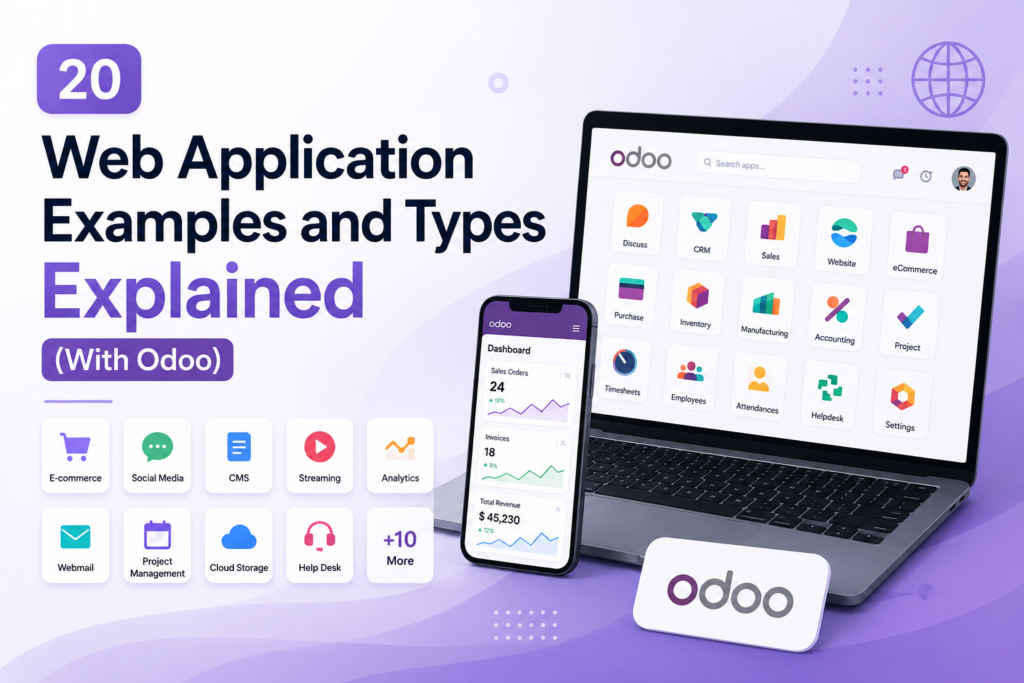
Most of the examples above solve one problem each: a CMS handles content, an e-commerce platform handles sales, a portal handles partner access. Odoo takes a different approach. It is a web-based application that combines many of these functions into one connected system, accessible entirely through a browser.
Inside Odoo, a business gets a dynamic dashboard for daily operations, a built-in e-commerce module for online sales, a portal for vendors and customers to log in and check orders, and a CMS-style website builder for the public-facing site, all sharing the same underlying data. A sales order placed through the e-commerce module updates inventory in real time and shows up instantly on the dashboard a warehouse manager is using.
This matters for growing businesses because it removes the need to stitch together five separate tools that do not talk to each other. A retail business running a Shopify store, a separate CMS for its blog, and a spreadsheet for inventory has three disconnected systems. Running the same business on Odoo means one login, one database, and no manual syncing between tools.
For companies in Hong Kong and Malaysia weighing custom software against an existing platform, Odoo often sits in the middle. It gives you the flexibility of a custom build, since every module can be configured to match specific workflows, without the cost and timeline of building a full system from scratch.
How to Choose the Right Type for Your Business
Start with what the application needs to do, not what looks impressive. If you only need to share information, a static page costs the least and loads the fastest. If users need accounts or personalization, you need a dynamic build. If you are selling directly, you need e-commerce functionality. If different user groups need different views of the same data, a portal solves that. If you want app-like speed without app store overhead, look at a PWA. If your product is something people use constantly throughout the day, an SPA usually feels better. If SEO and large content volume matter most, an MPA structure wins long term.
Many businesses end up needing a mix of these, which is exactly the gap a platform like Odoo is built to close.
Final Thoughts
The type of web application you choose shapes your development cost, your timeline, and how well the product scales. Getting this right before development starts saves you from expensive rebuilds later, and for businesses juggling multiple disconnected tools, an integrated platform like Odoo is often the more practical long-term answer.
BoyangCS works across all eight web application types covered here, from static landing pages to full Odoo ERP implementations, for clients across Hong Kong, China, and Malaysia.
Frequently Asked Questions
What is the difference between a website and a web application?
A website mainly displays information. A web application lets users interact with and act on that information, submitting forms, processing payments, or managing data.
What are the most common types of web applications?
The eight main types are static, dynamic, e-commerce, CMS, portal, progressive web app, single page application, and multi page application.
What is an example of a web application?
Gmail, Netflix, and Amazon are all examples. Each one runs inside a browser and updates based on user interaction.
Is Odoo a web application?
Yes. Odoo runs entirely through a browser and combines several web application types, dynamic dashboards, e-commerce, portals, and content management, into one connected system.
Should I build a custom web application or use an existing platform like Odoo?
Use a single-purpose platform like Shopify or WordPress when you only need one function. Choose Odoo when you need multiple connected functions, sales, inventory, customer portals, and content, working from one shared database without manual syncing between separate tools.