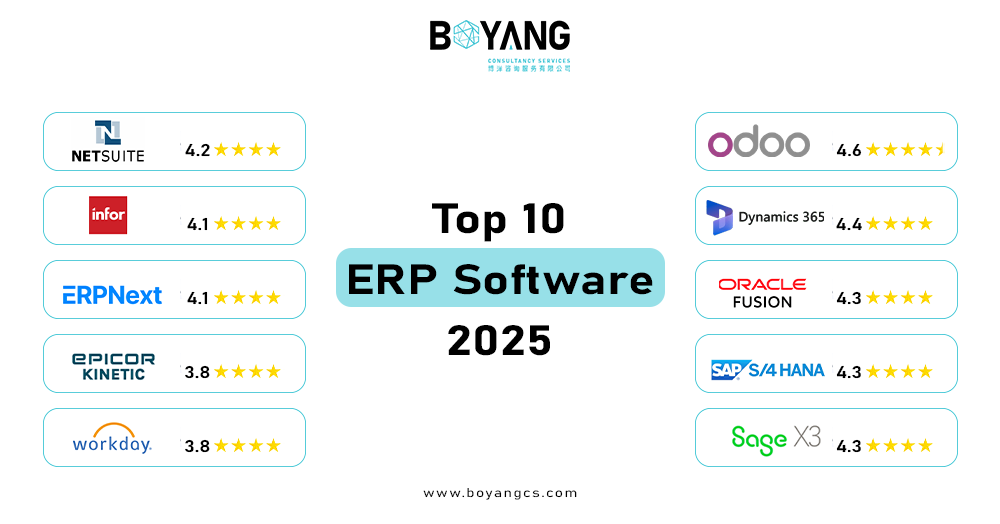
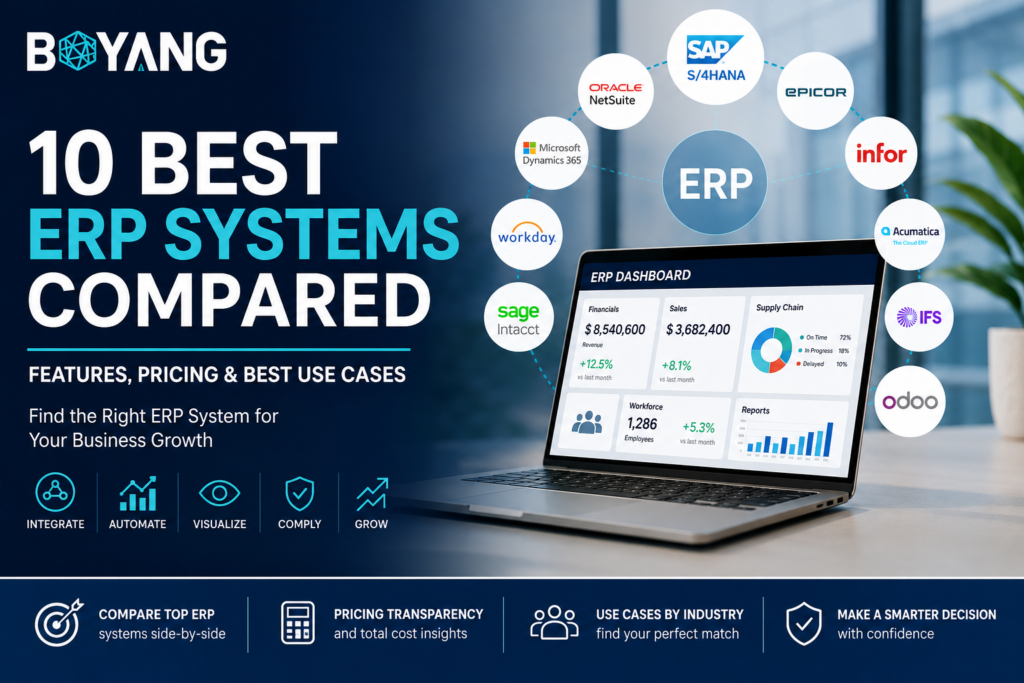
Choosing the right ERP system is one of the most important decisions your business will make. The wrong choice costs you time, money, and momentum. The right one connects your entire operation, from finance and HR to supply chain and sales, into a single source of truth.
This guide compares the 11 best ERP systems available in 2026. You will find what each one does well, who it fits best, and where it falls short. Whether you are a mid-market manufacturer, a fast-growing distributor, or a finance-focused enterprise, use this to make a faster, smarter decision.
What Is an ERP System?
ERP stands for Enterprise Resource Planning. It is software that integrates your core business processes into one unified platform. Instead of managing separate tools for accounting, inventory, HR, and operations, an ERP connects them all.
The result: less duplicate data entry, better visibility across departments, and faster decision-making.
Modern cloud ERP systems go further. They add AI-powered forecasting, real-time reporting, multi-currency support, and integrations with CRM, e-commerce, field service, and payroll platforms, all from a single login.
How We Compared These ERP Systems
We evaluated each platform across six areas:
- Core functionality and module depth
- Ease of deployment (cloud vs. on-premise)
- Pricing structure and total cost of ownership
- Scalability for growing businesses
- Industry fit and customization options
- Integration with HR, payroll, supply chain, and CRM tools
Pricing figures reflect publicly available data as of 2026. Always request a current quote directly from vendors before budgeting.
1. SAP S/4HANA
Best for: Large enterprises with complex global operations
SAP S/4HANA is the benchmark for enterprise-level ERP. It runs on an in-memory database, which means real-time data processing at scale. It covers finance, procurement, manufacturing, supply chain, HR, and more.
The platform supports operations in 180+ countries with multi-currency, multi-language, and multi-entity handling built in. For large manufacturers, energy companies, and global conglomerates, SAP S/4HANA remains the most comprehensive option on the market.
Strengths:
- Unmatched depth across all core modules
- Industry-specific solutions for 25+ verticals including manufacturing, energy, and retail
- Powerful analytics and embedded AI features
- Strong compliance tools for global regulatory needs including PAYE, GST, and multi-region tax
Weaknesses:
- Very high implementation cost, often $500K to several million dollars
- Long deployment timelines, typically 12 to 24 months
- Steep learning curve for non-technical users
- Overkill for companies under 500 employees
Pricing: Custom enterprise pricing. Expect six-figure annual licensing minimums. Cloud edition runs approximately $200 to $400 per user per month.
Ideal company size: 500+ employees
Verdict: SAP S/4HANA is the right choice if you run a large, complex organization with global operations. For small and mid-size businesses, the cost and complexity are not justified.
2. Oracle NetSuite
Best for: Fast-growing mid-market companies and multi-entity businesses
Oracle NetSuite is the most widely adopted cloud ERP for mid-market companies. It covers financial management, CRM, e-commerce, inventory, and HR in a single cloud platform. There is no on-premise version.
NetSuite scales well. You start with core financials and add modules as you grow. Its multi-subsidiary and multi-currency features make it a strong choice for businesses expanding internationally.
Strengths:
- True cloud-native architecture
- Strong multi-subsidiary, multi-currency, and multi-entity support
- Good customization through SuiteScript and SuiteFlow
- Large partner and consulting ecosystem
- Integrates well with CRM, e-commerce, and supply chain tools
Weaknesses:
- Pricing adds up quickly as you add users and modules
- Customer support quality varies by partner
- Advanced manufacturing features are limited compared to SAP or Epicor
Pricing: Base license starts around $999/month, plus approximately $99 to $149 per user per month. Total annual costs typically range from $30K to $150K+ depending on modules and users.
Ideal company size: 50 to 1,000 employees
Verdict: NetSuite is one of the best cloud ERP options for growing businesses that need full-featured financial management, multi-entity support, and scalability without SAP-level complexity.
3. Microsoft Dynamics 365
Best for: Businesses already using Microsoft tools including Office 365, Azure, and Teams
Microsoft Dynamics 365 is a modular ERP and CRM platform built into the Microsoft ecosystem. You choose the apps you need, including Finance, Supply Chain Management, Business Central, or Sales, and pay only for what you use.
Its integration with Power BI, Excel, Teams, and Azure is a major advantage for Microsoft-heavy organizations. Business Central targets mid-size companies. Dynamics 365 Finance targets larger enterprises.
Strengths:
- Tight integration with the entire Microsoft stack
- Flexible modular structure
- Strong AI and Power Platform capabilities
- Available in both cloud and on-premise deployments
- Good fit for medium-sized businesses evaluating cloud ERP
Weaknesses:
- Module fragmentation makes full deployment complex
- Licensing model is difficult to navigate without a partner
- Implementation requires skilled Dynamics consultants
Pricing: Business Central starts around $70 per user per month. Dynamics 365 Finance starts around $180 per user per month.
Ideal company size: 50 to 2,000+ employees depending on module
Verdict: If your organization runs on Microsoft tools, Dynamics 365 reduces friction and delivers a familiar, powerful experience. It is one of the top cloud ERP options for medium-sized businesses already invested in the Microsoft ecosystem.
4. Workday
Best for: Enterprise HR, workforce management, and financial planning
Workday started as an HR platform and expanded into a full financial management and planning solution. It is the top choice for organizations where people management is central to operations.
It is 100% cloud-based with no on-premise option. Its interface is clean and user-friendly compared to most legacy ERPs. Workday Adaptive Planning adds strong budgeting, forecasting, and scenario modeling capabilities.
Strengths:
- Best-in-class HR, payroll, and talent management
- Strong financial planning and analytics through Workday Adaptive Planning
- Excellent mobile experience
- Frequent product updates with no version upgrades needed
- Strong compliance support for labor, benefits, and data privacy regulations
Weaknesses:
- Not built for manufacturing, supply chain, or inventory-heavy businesses
- High cost relative to mid-market alternatives
- Fewer third-party integrations than SAP or Oracle
Pricing: Custom pricing. Enterprise contracts typically start at $100K+ annually. Estimated $200+ per user per month at scale.
Ideal company size: 500+ employees
Verdict: Workday is the top ERP for large professional services, healthcare, and financial services firms focused on workforce management and financial planning. It is less suited for operations-heavy or manufacturing environments.
5. Sage Intacct
Best for: Mid-size businesses that want deep financial management without full ERP complexity
Sage Intacct is a cloud financial management platform built for finance teams. It is recognized by the AICPA and stands out for multi-entity accounting, dimensional reporting, and fast month-end close.
For companies comparing Sage Intacct vs NetSuite, Sage Intacct wins on pure accounting depth and ease of use. NetSuite wins when you also need inventory, manufacturing, or CRM in the same system.
Strengths:
- Best-in-class core financials and multi-entity accounting
- Strong grant and fund accounting for nonprofits
- Good automation for accounts payable and receivable
- Open API for integrations with HR, payroll, and CRM tools
- Solid reporting accuracy and audit trail capabilities
Weaknesses:
- Not a full ERP. Limited HR, inventory, and manufacturing capabilities
- Requires third-party tools for complete operational coverage
- Fewer built-in modules than NetSuite or Dynamics 365
Pricing: Starts around $15,000 to $25,000 per year. Scales with modules and users. Approximately $100 per user per month.
Ideal company size: 20 to 500 employees
Verdict: Sage Intacct is ideal if your primary need is sophisticated financial management. If you need deeper operational coverage, pair it with purpose-built tools or evaluate NetSuite instead.
6. Epicor Kinetic
Best for: Manufacturing and distribution companies
Epicor Kinetic is purpose-built for manufacturing. It covers discrete, process, and mixed-mode manufacturing with deep functionality for production planning, shop floor control, MRP, MES, and quality management.
It is one of the strongest manufacturing ERP options for mid-to-large manufacturers who need more than what NetSuite or Dynamics 365 offer out of the box.
Strengths:
- Deep manufacturing module with strong MRP and MES capabilities
- Good fit for job-shop, make-to-order, and engineer-to-order environments
- Industry-specific features for automotive, electronics, and industrial manufacturers
- Available in cloud and on-premise
- Strong for distribution and supply chain management
Weaknesses:
- Interface is less modern than newer cloud platforms
- High implementation complexity
- Less suitable for non-manufacturing industries
Pricing: Custom pricing. Typically $1,500 to $3,000+ per user annually, or approximately $100 to $175 per user per month.
Ideal company size: 100 to 2,000 employees
Verdict: If you run a manufacturing operation and need a purpose-built ERP for the shop floor, Epicor Kinetic is one of the strongest options in its class. For large manufacturers comparing IFS vs SAP vs Epicor, each serves specific production environments differently.
7. Infor CloudSuite
Best for: Industry-specific mid to large enterprises
Infor builds ERP solutions tailored to specific industries including healthcare, hospitality, fashion, food and beverage, and aerospace. Its CloudSuite products are cloud-native and include pre-built industry workflows, which reduces the customization burden compared to generic platforms.
Strengths:
- Deep industry-specific functionality out of the box
- Strong for asset-intensive and service-oriented industries
- Built on AWS with good scalability
- Includes Birst analytics and Coleman AI
- Competitive in energy, utilities, and aerospace sectors
Weaknesses:
- Less recognized outside its core verticals
- Partner ecosystem is smaller than SAP or Oracle
- UI feels dated in some modules
Pricing: Custom enterprise pricing. Comparable to mid-to-upper-market ERP costs. Approximately $150 to $250 per user per month.
Ideal company size: 200 to 5,000 employees
Verdict: If your industry is one of Infor’s core verticals, CloudSuite delivers pre-configured functionality that reduces implementation time and cost. It competes directly with SAP, Oracle, and Microsoft Dynamics in energy, healthcare, and manufacturing sectors.
8. Acumatica
Best for: Small to mid-size businesses wanting flexible, affordable cloud ERP
Acumatica is a cloud ERP built for growing businesses. Its pricing model is unique. It charges by computing resources rather than per user, which makes it cost-effective for teams where many people need system access.
For companies comparing Acumatica vs Odoo or Acumatica vs NetSuite, Acumatica sits in the middle, more capable than Odoo for operations-heavy businesses and more affordable than NetSuite at scale.
Strengths:
- Unlimited user licensing model
- Strong construction, distribution, and manufacturing editions
- Good mobile capabilities
- Open API and developer-friendly platform
- Strong multi-currency and multi-branch support for growing businesses
Weaknesses:
- Less brand recognition in the enterprise space
- Smaller consulting partner network
- Reporting tools are not as advanced as NetSuite or SAP
Pricing: Starts around $1,000 to $2,000 per month depending on edition and computing resources. Approximately $1,800 per month as a baseline.
Ideal company size: 20 to 500 employees
Verdict: Acumatica is a strong value pick for growing SMBs that want full ERP functionality without per-user pricing penalties. It is one of the best cloud ERP alternatives to NetSuite for mid-market distribution and manufacturing companies.
9. IFS Cloud
Best for: Asset-intensive industries including aerospace, defense, energy, and field service
IFS Cloud is an ERP built around the asset and service lifecycle. It is the top choice for organizations managing complex equipment, long-term projects, or large field service operations.
For companies in energy, utilities, aerospace, and defense comparing IFS vs SAP vs Oracle, IFS consistently leads in field service management and asset management depth.
Strengths:
- Best-in-class field service management (FSM)
- Strong project-based and asset management functionality
- Modern cloud interface with role-based workspaces
- Strong MRO (maintenance, repair, and overhaul) capabilities
- Competitive in multi-region compliance and project accounting
Weaknesses:
- Less suited for retail, consumer goods, or HR-heavy organizations
- Implementation requires specialized IFS partners
- Higher cost than general-purpose mid-market ERPs
Pricing: Custom pricing. Approximately $150 to $250 per user per month.
Ideal company size: 200 to 5,000 employees
Verdict: IFS Cloud is the top ERP for organizations where asset management, project delivery, or field service are core to operations. It competes strongly with SAP and Oracle in asset-intensive industries.
10. Odoo
Best for: Small businesses and startups wanting affordable, modular ERP
Odoo is an open-source ERP with a large library of business apps. It covers CRM, sales, inventory, accounting, HR, manufacturing, website, and e-commerce. You start with what you need and add more over time.
For companies comparing Odoo vs NetSuite or Odoo vs Acumatica, Odoo wins on price and flexibility. It loses on depth and enterprise-grade support.
Strengths:
- Very affordable entry point including a free community edition
- Wide range of modules covering almost every business function
- Active open-source community with thousands of integrations
- Easy to get started for non-technical users
- Good fit for companies looking for cost-effective alternatives to SAP or NetSuite
Weaknesses:
- Enterprise version costs more than it first appears once you add users and apps
- Not suitable for large or complex global operations
- Support quality depends heavily on your implementation partner
Pricing: Community edition is free. Enterprise edition starts around $24.90 per user per month. Odoo Online (hosted) adds hosting fees.
Ideal company size: 1 to 200 employees
Verdict: Odoo is the best starting point for small businesses and startups that need full ERP functionality on a tight budget. It is the most accessible affordable ERP alternative to SAP and NetSuite for companies under 200 employees.
ERP Systems Side-by-Side Comparison 2026
| ERP System | Best For | Deployment | Starting Price | Ideal Company Size |
|---|---|---|---|---|
| SAP S/4HANA | Large global enterprises | Cloud / On-premise | ~$200 to $400/user/month | 500+ employees |
| Oracle NetSuite | Growing mid-market companies | Cloud only | ~$99 to $149/user/month + $999/month base | 50 to 1,000 employees |
| Microsoft Dynamics 365 | Microsoft ecosystem users | Cloud / On-premise | ~$70 to $210/user/month | 50 to 2,000+ employees |
| Workday | HR-heavy enterprises | Cloud only | ~$200+/user/month | 500+ employees |
| Sage Intacct | Finance-focused mid-market | Cloud only | ~$100/user/month | 20 to 500 employees |
| Epicor Kinetic | Manufacturers and distributors | Cloud / On-premise | ~$100 to $175/user/month | 100 to 2,000 employees |
| Infor CloudSuite | Industry-specific enterprises | Cloud | ~$150 to $250/user/month | 200 to 5,000 employees |
| Acumatica | Growing SMBs | Cloud | ~$1,800/month resource-based | 20 to 500 employees |
| IFS Cloud | Asset and service industries | Cloud / On-premise | ~$150 to $250/user/month | 200 to 5,000 employees |
| Odoo | Startups and small businesses | Cloud / On-premise | ~$25 to $35/user/month | 1 to 200 employees |
Other ERP Alternatives Worth Knowing
The 10 vendors above cover most businesses, but a few smaller platforms come up often when companies shop for NetSuite or Odoo alternatives. Here is a quick look at each.
Deskera ERP: A budget cloud ERP aimed at small manufacturers and SMBs that want accounting, inventory, and HR without Odoo’s setup work.
Focus X: A mid-market ERP popular in Asia, positioned as a lower-cost, faster-to-deploy alternative to Odoo for retail and trading businesses.
Striven: An all-in-one platform combining accounting, CRM, and operations for small businesses that want one login instead of stitching together separate apps.
BizAutomation: A cloud ERP built for distributors and e-commerce sellers who need inventory and order management to scale without moving to NetSuite.
Kechie: A cloud ERP focused on inventory-heavy businesses, often compared to NetSuite by distributors who want a lighter, more affordable option.
Xledger: A cloud accounting and ERP platform built around automation, often shortlisted against NetSuite by finance teams that want less manual reporting work.
Multiview ERP: A financial management platform aimed at mid-market finance teams who want stronger reporting than NetSuite without full ERP complexity.
Versa Cloud ERP: A multi-entity ERP for product-based businesses, often compared to Acumatica for manufacturing and distribution features.
None of these require the budget or implementation timeline of SAP or Oracle, which is why they show up in searches from smaller and mid-size businesses.
Best ERP by Industry
| Industry | Recommended ERP Systems |
|---|---|
| Manufacturing | Epicor Kinetic, IFS Cloud, SAP S/4HANA |
| Nonprofits | Sage Intacct |
| Healthcare | Workday, Infor CloudSuite |
| Professional services | Workday, Sage Intacct |
| Hospitality | Infor CloudSuite |
| Energy and utilities | SAP S/4HANA, Infor CloudSuite, IFS Cloud |
| Aerospace and defense | IFS Cloud, SAP S/4HANA |
| Distribution | Acumatica, Epicor Kinetic |
| Startups and small business | Odoo, Acumatica |
| Multi-entity global operations | Oracle NetSuite, SAP S/4HANA |
How to Choose the Right ERP for Your Business
Before you shortlist vendors, answer these four questions.
1. What is your primary pain point? If it is finance and multi-entity reporting, look at NetSuite or Sage Intacct. If it is manufacturing or supply chain, look at Epicor or IFS. If it is HR, payroll, and workforce management, look at Workday.
2. What is your realistic budget? Include implementation, training, and annual licensing. Implementation typically costs 1x to 3x the annual license fee. Cloud ERP options like Odoo and Acumatica reduce upfront costs significantly compared to SAP or Oracle.
3. How fast do you need to go live? Some ERPs deploy in 3 months. Others take 18 months. Odoo and Acumatica tend to deploy faster. SAP and Oracle take longer. Align timeline expectations before choosing.
4. How important is industry fit? A generic ERP requires more customization. An industry-specific ERP like Epicor for manufacturing or IFS for field service reduces that burden but limits flexibility in other areas.
5. How many users need access? Per-user pricing from SAP, Oracle, and Workday adds up fast. If you have a large team that needs system access, Acumatica’s resource-based model or Odoo’s flat pricing structure may deliver better value.
ERP by Use Case: Quick Reference
Best for financial management: Oracle NetSuite, Sage Intacct, SAP S/4HANA
Best for manufacturing ERP: Epicor Kinetic, IFS Cloud, SAP S/4HANA
Best for HR and payroll: Workday, Microsoft Dynamics 365, SAP S/4HANA
Best for small businesses and startups: Odoo, Acumatica
Best for mid-market companies (200 to 5,000 employees): Oracle NetSuite, Acumatica, Microsoft Dynamics 365, Infor CloudSuite
Best for multi-currency and multi-entity operations: Oracle NetSuite, SAP S/4HANA, Acumatica
Best for field service and asset management: IFS Cloud, Microsoft Dynamics 365
Best affordable alternatives to SAP and NetSuite: Odoo, Acumatica, Sage Intacct
Best cloud ERP for Microsoft users: Microsoft Dynamics 365
Frequently Asked Questions
Which ERP system is best for mid-market companies?
Oracle NetSuite and Microsoft Dynamics 365 are the most widely used cloud ERP platforms for mid-market companies with 50 to 1,000 employees. Acumatica is a strong alternative for companies that want to avoid per-user pricing.
What is the most affordable ERP system?
Odoo is the most affordable ERP option with a free community edition and enterprise pricing starting at $24.90 per user per month. Acumatica offers strong value for teams with many users due to its resource-based pricing model.
Which ERP is best for manufacturing?
Epicor Kinetic and IFS Cloud lead for manufacturing and asset-intensive industries. SAP S/4HANA is the enterprise standard but comes at a significantly higher cost. For mid-market manufacturers, Acumatica and Microsoft Dynamics 365 are strong alternatives.
How does SAP compare to Oracle NetSuite?
SAP S/4HANA is deeper, more complex, and more expensive. It is designed for large global enterprises. Oracle NetSuite is cloud-native, faster to deploy, and better suited for mid-market companies. Most businesses with under 500 employees are better served by NetSuite.
Which ERP platforms support multi-currency and multi-entity operations?
Oracle NetSuite, SAP S/4HANA, Microsoft Dynamics 365, and Acumatica all offer strong multi-currency, multi-entity, and multi-region capabilities. NetSuite is a top choice for international mid-market businesses managing multiple subsidiaries.
Which ERP systems handle multi-country payroll and tax compliance best?
SAP S/4HANA has the deepest built-in support for multi-region payroll and tax rules including PAYE, GST, and provident fund contributions, which makes it the top choice for large global employers. Oracle NetSuite and Microsoft Dynamics 365 also support multi-country payroll through partner add-ons, and both work well for mid-market companies operating across two or three countries.
What is the best ERP for a business outgrowing QuickBooks?
Oracle NetSuite and Sage Intacct are the most common upgrade paths from QuickBooks, since both handle multi-entity accounting and higher transaction volume that QuickBooks cannot support. If your main need is inventory and operations rather than just accounting, Acumatica or Odoo are worth evaluating as well.
There is no single best ERP. The right system depends on your industry, size, budget, and growth plans. Start by defining what your business needs most. Then shortlist two or three systems, request demos, and speak with reference customers in your industry. The ERP you choose will shape how your business operates for the next 5 to 10 years.