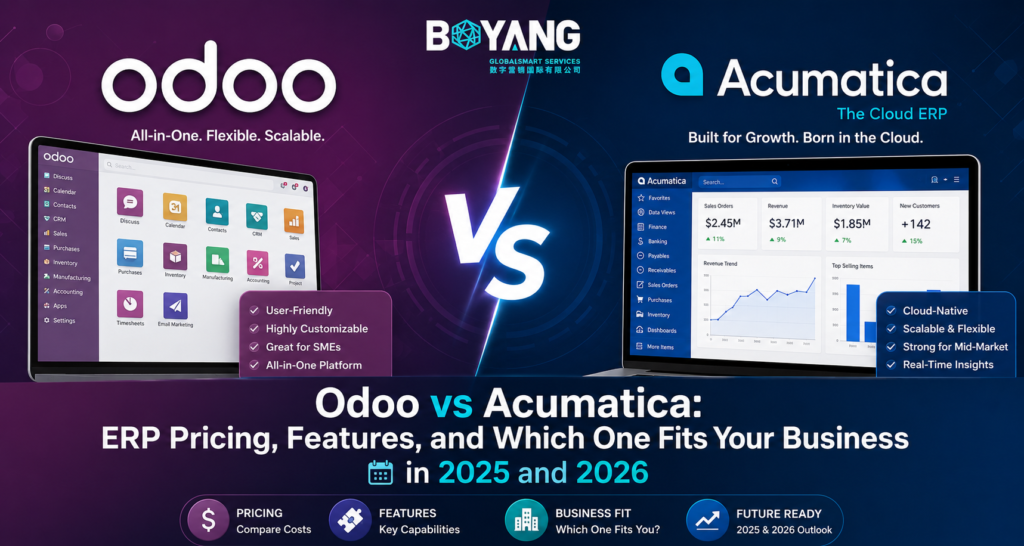
Choosing the wrong ERP is an expensive mistake. According to a 2025 ERP selection study, over 70% of businesses regret their ERP choice within two years. Most of them picked based on sticker price or a demo that looked impressive. If you are evaluating Odoo vs Acumatica right now, this comparison gives you the real picture: pricing models, operational depth, scalability, and which platform actually fits your business.
Both systems are serious ERP platforms. Neither is a bad choice in the abstract. But they are built for different buyers, and the gap between them widens significantly depending on your company size, industry, and how complex your operations are.
What Is Odoo?
Odoo started as OpenERP in 2005, founded in Belgium by Fabien Pinckaers. It rebranded to Odoo in 2014. Today it serves an estimated 30,000 paying customers across more than 100 countries.
The platform is modular and open-source at its core. It covers over 50 business applications including CRM, accounting, inventory, manufacturing, e-commerce, HR, and project management. You pay for what you use. The Community edition is free but requires self-hosting and comes with no official support. The Enterprise edition adds cloud hosting, support, and full feature access.
Odoo targets smaller businesses, typically those with fewer than 200 employees and revenues under $10 million. At Odoo Experience 2025, the company reported 650 million euros in billing revenue with 42% ARR growth, and it is aiming for 1 billion euros by 2027. A 500 million euro raise pushed its valuation to 5 billion euros, backed by CapitalG.
The platform is strong in Europe and the Middle East, where roughly 70% of its customer base sits. North American adoption is growing but remains a secondary market.
What Is Acumatica?
Acumatica was founded in 2008 and has grown to serve over 10,000 customers worldwide. It is a cloud-native ERP built specifically for small and mid-market businesses with revenues between $10 million and $100 million.
Unlike most ERP vendors, Acumatica does not charge per user. It uses a consumption-based pricing model tied to transaction volume and resource usage. This makes it particularly attractive for companies with large teams where per-user fees would stack up quickly.
The platform focuses on four primary verticals: manufacturing, distribution, construction, and professional services. Its AI Studio feature, introduced in 2025, allows business users to build AI-driven workflows without needing a developer. The current roadmap is heavily focused on AI-powered analytics, automated compliance tools, and deeper industry-specific functionality.
Acumatica runs on AWS and Microsoft Azure and delivers real-time data, role-based dashboards, and native mobile applications out of the box.
Odoo vs Acumatica Pricing: The Real Numbers
This is where most comparison guides get lazy. They list headline prices without explaining what those prices actually include or how they change as your business grows.
Odoo Pricing in 2025 and 2026
Odoo Enterprise offers two plans. The Standard plan costs $24.90 per user per month and includes all apps. The Custom plan costs $37.40 per user per month and adds features like multi-company support and advanced customization options.
The Community version is completely free. You host it yourself, configure it yourself, and get no official support. For businesses with Python developers on staff, this is a serious option. For everyone else, it adds hidden costs in time and technical overhead.
Here is how Odoo pricing scales in practice. Ten users on the Standard plan costs roughly $2,988 per year in licensing alone. Fifty users costs $14,940. Those numbers look affordable at first glance. Add implementation costs, partner fees, and custom development, and the total investment looks different.
Odoo’s typical total cost of ownership ranges from $10,000 to $80,000 depending on complexity and the number of modules selected.
Acumatica Pricing in 2025 and 2026
Acumatica does not publish pricing publicly. All quotes are customized based on your transaction volume, the edition you choose, and the modules you need.
Based on 2025 and 2026 market data, the General Business Edition starts at approximately $6,000 per year. This includes 5 user licenses and 1,000 monthly transactions. Pricing scales upward based on Commercial Transaction Volume (CTV), which tracks key business transactions like sales orders, AP invoices, and shipments.
For mid-market companies, annual Acumatica costs typically range from $25,000 to $100,000 or more. The typical total cost of ownership runs from $75,000 to $350,000 when you include implementation.
That sounds significantly more expensive than Odoo. It often is, especially at the entry level. But the math changes at scale. Acumatica’s pricing advantage appears most clearly when you have 150 or more users. At that point, paying per user with Odoo becomes more expensive than paying for resources with Acumatica. For businesses with large numbers of occasional or light users such as field technicians, warehouse staff, and customer portal users, the savings with Acumatica are substantial.
One distribution company, ProPharma, reported saving $120,000 annually after switching to Acumatica’s unlimited-user model.
Which Pricing Model Fits Your Business?
Choose Odoo pricing if you have fewer than 50 users, a tight initial budget, and moderate transaction volumes. Choose Acumatica pricing if you have 100 or more users, high transaction volumes, or need multi-entity support across several companies or locations.
Features and Operational Depth: Odoo vs Acumatica
Both platforms cover the standard ERP modules. The difference is depth, not breadth.
Financial Management
Acumatica’s financial management is consistently rated as one of its strongest areas. It handles multi-entity consolidation, multi-currency transactions, advanced reporting, and intercompany accounting natively. On G2, Acumatica scores higher for accounts payable and financial reporting functionality.
Odoo’s accounting module is solid for single-entity businesses. Multi-company features exist in the Custom plan but require more configuration and partner support to set up cleanly. For straightforward bookkeeping and invoicing, Odoo performs well. For complex financial structures, Acumatica has the edge.
Inventory and Distribution
For distribution companies managing multiple warehouses, Acumatica provides deeper operational structure. It handles multi-warehouse coordination, fulfillment workflows, purchasing visibility, and replenishment automation as integrated functions rather than add-ons.
Odoo handles distribution effectively for most small to mid-size businesses. The gap with Acumatica shows up when operations grow to multiple warehouses, complex fulfillment logic, or high transaction volumes that require real-time coordination.
Manufacturing
Acumatica’s manufacturing depth is comparable to mid-range dedicated MES systems. It handles advanced planning and scheduling (APS), production order management, material requirements planning, and process manufacturing. Discrete manufacturers and companies with complex production workflows tend to choose Acumatica for this reason.
Odoo’s manufacturing module covers the needs of roughly 80% of mid-market manufacturers. It handles bills of materials, work orders, quality control, and basic MRP effectively. The gap with Acumatica appears in advanced scheduling boards, MES integration, and process manufacturing scenarios where precision and real-time shop floor visibility matter.
CRM and Sales
This is one of Odoo’s strongest areas. Its CRM module integrates natively with e-commerce, email marketing, and sales pipelines. The interface is clean and well-reviewed. Businesses that rely heavily on CRM, live chat, and marketing automation often find Odoo more practical for those workflows than Acumatica.
Acumatica includes CRM but it is not its primary strength. Companies choosing Acumatica for CRM functionality alone are likely paying more than they need to.
Project Management and Professional Services
Acumatica has a dedicated Project Accounting module built for professional services firms. It tracks project budgets, costs, billing, and resource utilization in real time, connected directly to financials.
Odoo’s project management features are broad but less financially integrated. For services businesses that need project costing tied directly to accounting, Acumatica provides a cleaner solution.
Deployment and Customization
Odoo offers on-premise, private cloud, and public cloud deployment. Its open-source architecture gives developers full access to source code. Customization is done in Python, and the large community ecosystem means third-party modules for almost any use case already exist.
The trade-off is maintenance. Deep customizations require developer involvement to sustain through version upgrades. Businesses without in-house technical resources will need a partner for ongoing support.
Acumatica is cloud-native first. Private cloud hosting is available but the platform is optimized for SaaS delivery. Customization is handled through the xRP framework using .NET, with stricter controls designed to maintain upgrade compatibility. The low-code Studio tool allows non-technical staff to configure workflows without developer support, which reduces long-term support costs for many businesses.
The upgrade experience with Acumatica is generally smoother because customizations are isolated from the core platform. With Odoo, heavily customized instances can require significant rework during major version upgrades.
Implementation Time and Costs
Implementation timelines differ significantly between the two platforms.
Odoo typically takes 1 to 4 months to implement depending on complexity. The modular structure means you can start with core modules and add more over time. This phased approach works well for smaller businesses that need to get operational quickly.
Acumatica implementations typically take 4 to 8 months. The longer timeline reflects deeper configuration requirements and the complexity of the mid-market use cases it targets. If you are running multi-entity operations or complex manufacturing workflows, the extra time is usually necessary to set up the system correctly.
Both platforms require implementation partners. Odoo has a larger global partner network. Acumatica’s partner ecosystem is more concentrated in North America, which matters if you need local support in other regions.
Scalability: Which ERP Grows With You?
This question has a clear answer depending on where you are starting from.
Odoo scales well from zero to approximately $10 million in revenue. The modular architecture means you add functionality as you need it without replacing the whole system. For startups and early-stage businesses, this is a significant advantage.
Above $10 million in revenue and 50 to 100 employees, operational complexity tends to outpace what Odoo handles cleanly without significant customization investment. Businesses at this stage often find themselves spending heavily on custom development to fill gaps, which erodes the cost advantage.
Acumatica is designed for companies already in the $10 million to $100 million range. Its architecture handles multi-entity operations, high transaction volumes, and complex industry workflows without the same level of custom development that Odoo requires at scale. If your business is at this stage or growing toward it, Acumatica provides stronger operational infrastructure.
Integration Ecosystem
Odoo integrates natively with Stripe, Meta for Business, Instagram, and a wide range of e-commerce and marketing tools. Its open-source nature means the integration ecosystem is large, though quality varies between community-built and official connectors.
Acumatica integrates with BigCommerce, Dropbox Business, Microsoft Excel, and a range of supply chain and logistics tools. Its API is well-documented and designed for enterprise-grade integrations. Power BI connectivity is strong, which matters for businesses that need external reporting and data analysis.
Both platforms support REST APIs and web services. Acumatica’s integration architecture is generally more stable under high transaction loads.
Customer Support and Community
Odoo support is tiered. Community edition users get no official support. Enterprise users get access to official Odoo support, but user reviews consistently flag response times and quality as areas of concern. The community forum and partner network fill much of the gap for day-to-day issues.
Acumatica provides support through certified Value Added Resellers (VARs). Direct vendor support is available for critical issues. G2 data ranks Acumatica higher in overall customer satisfaction and support experience compared to Odoo.
Odoo vs Acumatica for Specific Industries
Manufacturing
Acumatica is the stronger choice for discrete manufacturers, process manufacturers, and companies with complex scheduling requirements. Odoo works well for businesses with simpler production processes, job shop manufacturing, and small batch production.
Distribution and Wholesale
Acumatica provides stronger multi-warehouse, multi-entity distribution capabilities. Odoo handles distribution adequately for single-location or straightforward fulfillment operations.
Construction
Acumatica has a dedicated Construction Edition built for project cost tracking, subcontractor management, budget monitoring, and compliance. Odoo does not have a comparable vertical solution for construction.
Retail and E-commerce
Odoo is strong here. Its native e-commerce module, point of sale integration, and marketing tools make it a practical all-in-one option for retail businesses. Acumatica has retail capabilities but e-commerce is not its primary strength.
Professional Services
Acumatica’s project accounting capabilities make it the better fit for professional services firms that need real-time project costing tied to financial management. Odoo works for lighter project tracking but lacks the financial depth for services firms with complex billing structures.
ERP Market Context for 2025 and 2026
The broader ERP market gives useful context for this comparison. Mordor Intelligence puts the global ERP market at $71.62 billion in 2025, growing to $78.15 billion in 2026 at a 9.12% CAGR through 2031. Cloud ERP is growing faster, with Fortune Business Insights tracking the cloud segment at $65.89 billion in 2025 at a 13.40% CAGR through 2034. On-premise ERP growth sits at roughly 2% annually.
Both Odoo and Acumatica are positioned for cloud-first delivery, which aligns with where the market is heading. Acumatica made a significant ownership change in 2025, which has implications for its product roadmap and investment levels. Odoo’s recent funding round and revenue growth signal continued development across its module ecosystem.
Odoo vs Acumatica: Side-by-Side Summary
Company Size: Odoo suits businesses with 1 to 200 employees. Acumatica suits businesses with 50 to 1,000 employees.
Revenue Range: Odoo is built for businesses under $10 million in revenue. Acumatica targets businesses in the $10 million to $100 million range.
Pricing Model: Odoo charges per user per month, starting at $24.90. Acumatica charges based on transaction volume, starting around $6,000 per year.
Implementation Time: Odoo takes 1 to 4 months. Acumatica takes 4 to 8 months.
Total Cost of Ownership: Odoo typically runs $10,000 to $80,000. Acumatica typically runs $75,000 to $350,000.
Customization: Odoo offers deep, developer-driven customization in Python. Acumatica offers lower-code customization designed for upgrade stability.
Manufacturing Depth: Acumatica is stronger for complex manufacturing. Odoo covers the majority of mid-market manufacturing needs.
CRM and Marketing: Odoo is stronger for CRM, e-commerce, and marketing automation.
Support: Acumatica scores higher in user satisfaction and support quality on G2.
Partner Network: Odoo has a larger global network. Acumatica’s partners are concentrated in North America.
Who Should Choose Odoo?
Choose Odoo if your business has fewer than 200 employees, revenues under $10 million, and a need for broad functional coverage at a lower entry cost. It works well for startups, e-commerce businesses, service companies with light project management needs, and businesses that want to start small and expand module by module.
If you have Python developers in-house or access to a reliable Odoo partner, the Community edition gives you a powerful platform with no licensing cost. If you are price-sensitive and need to go live quickly, the Enterprise edition at $24.90 per user per month is one of the most cost-effective ERP entry points available.
Who Should Choose Acumatica?
Choose Acumatica if your business operates in manufacturing, distribution, construction, or professional services with revenues above $10 million. If you manage multiple entities, multiple warehouses, or high transaction volumes, Acumatica’s architecture handles those requirements more reliably without the same level of custom development Odoo would need.
The consumption-based pricing model becomes advantageous when your team is large. At 100 or more users, the economics often favor Acumatica over Odoo’s per-user model. If you anticipate significant growth over the next three to five years and need an ERP that handles that growth without requiring a platform change, Acumatica is worth the higher upfront investment.
Making the Right ERP Decision
The most important factor in this comparison is not which platform has more features. Both platforms cover a wide range of ERP functions. The real question is which platform fits your current operations and where you will be in the next three to five years.
Start by mapping your current business processes. Identify the specific gaps your ERP needs to fill. Be honest about your team’s technical capacity, your budget for implementation and ongoing support, and how much operational complexity you need to manage today versus what you anticipate needing in the future.
For businesses under $10 million in revenue with limited complexity, Odoo delivers strong value and broad functionality at a manageable cost. For businesses in manufacturing, distribution, or construction with revenues above $10 million and growing operational complexity, Acumatica provides the operational depth and scalability those workflows require.
If you are still uncertain after this comparison, the safest move is to engage an independent ERP consultant before committing. The cost of that consultation is far smaller than the cost of choosing the wrong platform.
Companies in the region looking for a local partner should review their options for Odoo Hong Kong implementation before committing to a vendor.