What is Odoo?
If you have ever found yourself toggling between a separate accounting tool, a standalone CRM, and three different Excel trackers, each demanding its own login and throwing off its own monthly bill, you already feel the problem Odoo was built to fix.
Odoo is an open-source, all-in-one business management platform that replaces your pile of disconnected software with a single, unified system. It launched in 2005 as Tiny ERP, was renamed OpenERP in 2009, and became Odoo in 2014, a name reflecting its broader ambition beyond traditional Enterprise Resource Planning. Today, it is used by millions of businesses across more than 100 countries, backed by a large, active global community of open source developers.
Three things set it apart from legacy giants like SAP or Oracle:
The code is publicly available with no vendor lock-in. The platform is modular, so you start with one free app and build from there. It was purpose-built for SMEs, businesses that need professional-grade tools without enterprise price tags.
What is Odoo ERP used for?
Odoo covers the full operating cycle of a business, from the first sales lead to the final customer invoice. Here is where companies across East Asian countries deploy it most consistently.
Accounting and Finance
Automated invoicing, bank reconciliation, and multi-currency profit and loss reporting, pre-configured for RMB, HKD, and TWD tax structures.
Sales and CRM
Pipeline management, lead scoring, automated follow-ups, and a quotation builder with e-signature.
Inventory and Warehouse
Multi-location stock, barcode scanning, make-to-order and make-to-stock reorder rules, and lot and serial number traceability for export compliance.
Manufacturing
Bill of materials, work orders, real-time shop floor monitoring, and IoT machine data capture. Operators can view real-time instructions on tablets instead of paper travelers, which cuts down on the manual entry mistakes that paper based systems tend to produce.
HR and Payroll
Contracts, leave, and appraisals. Handles the Hong Kong 713 Ordinance for payroll, automatically generating MPF reports for Hong Kong and mainland China and IRD-compliant tax filings for Taiwan and mainland China.
E-commerce and POS
An online storefront synced with inventory, point of sale for retail, food and beverage, and franchise chains, with ECPay invoices auto-generated for Taiwan.
How does Odoo work?
Most businesses run a best-of-breed stack: separate tools for each function, with staff manually re-entering data at every handoff. Odoo’s team calls this the copy-paste trap, a chain of steps that bleeds hours and introduces errors wherever it touches.
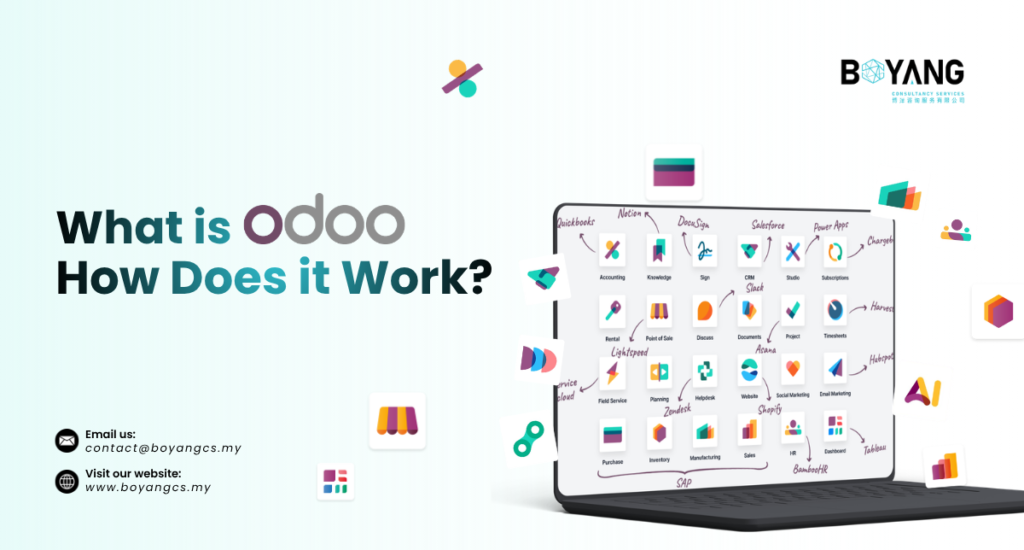
Odoo closes that loop with a shared database architecture. Every module, Sales, Inventory, Accounting, Manufacturing, and the rest, reads from and writes to the same central database in real time.
Odoo 19: The AI Agent Upgrade for 2026
The Odoo 19 release cycle, including the 19.x updates rolling out to Asia through 2026, represents the platform’s most significant leap in recent memory. AI agents are now embedded across every module.
AI-assisted lead research and scoring in CRM, cutting the manual qualification burden on sales teams. Automated bank reconciliation in Accounting, particularly valuable in high-volume environments like Hong Kong offices processing dozens of transactions daily. Predictive reorder suggestions in Inventory, essential for Chinese manufacturers managing thousands of SKUs across multiple supplier relationships.
The interface has also been performance tuned for speed, which matters for the high volume, fast paced data entry common in busy East Asian SME operations.
Key Features of Odoo
70-plus integrated applications, one flat license
A standard subscription gives you the entire suite, all 70-plus applications on one per-user fee, with no per-module surcharges. Compare that with competitors who bill separately for every add-on.
| Category | Included apps |
| Finance | Accounting, Invoicing, Expenses |
| Sales | CRM, Sales, Subscriptions, eSign |
| Operations | Inventory, Manufacturing, Purchase, PLM |
| People | HR, Payroll, Recruitment, Timesheets |
| Marketing | Email Marketing, SMS, Social Media Marketing |
| Website | eCommerce, Live Chat, Blog |
Open-source flexibility, no vendor lock-in
Odoo’s codebase lives on GitHub. Your implementation partner can modify any screen, workflow, or report without waiting on a vendor approval queue. For businesses in the region that need connectors to WeChat Pay, Alipay, Taobao and Tmall, or HSBC Autopay, that openness is not a luxury, it is a practical necessity.
Businesses with complex or industry-specific workflows often choose to hire an Odoo expert to build those integrations correctly from the ground up, rather than stretching out-of-the-box configurations until they break.
An entry point unlike any other ERP
One app, unlimited users, completely free, with no trial expiry. A factory in Dongguan can start with Inventory today, then layer in Manufacturing, Accounting, and HR as the business grows. No migration, no re-implementation, no big-bang moment. The platform scales with you.
How does Odoo IoT work?
For businesses in logistics or heavy manufacturing, manual data entry is one of the biggest drags on margin.
Odoo’s IoT Box is the hardware bridge that removes most of that friction. It is a plug-and-play device that connects your physical equipment to your Odoo database over your local network. Once paired, your machines and devices communicate with your ERP in real time, with no middleware software and no additional per-device license fee.
Automation on the floor: connect digital scales, calipers, or biometric scanners directly to Odoo. Machine monitoring: link production machinery to track uptime and trigger maintenance alerts automatically. Real-time traceability: scan barcodes at every stage of the supply chain to keep lot tracking accurate.
To keep these hardware-to-software connections seamless, many firms choose to hire an Odoo expert to build custom API bridges for specialized machinery.
How much does Odoo cost in 2026?
The question we hear most often from small business owners across the region: is Odoo expensive? Measured against five or six separate software subscriptions running in parallel, the answer is almost always no. Businesses switching from a combination of CRM, standalone accounting, and inventory tools typically report a meaningful reduction in total software spend.
Odoo’s pricing runs across three tiers.
| One App Free | Standard (Most Popular) | Custom |
| Free. Ideal for micro-businesses and startups exploring the platform.
Unlimited users. 1 app plus dependencies. Odoo Online hosting. |
Confirm current rate at odoo.com/pricing. Right starting point for SMEs with 5-200 employees.
All 70+ Odoo apps. Odoo Online hosting. Standard support. |
Confirm current rate at odoo.com/pricing. For multi-entity groups and manufacturers needing API access or on-premise.
All apps plus Odoo Studio. Multi-company management. External API and on-premise or Odoo.sh. |
Odoo adjusts pricing by region and by promotion, so confirm the current per-user rate on Odoo’s official pricing page before quoting a client.
Standard vs. Custom: which do you actually need?
The Standard Plan covers the vast majority of growing businesses in the region: every application, cloud hosting, and standard support. Step up to Custom if you manage multiple legal entities, need external API connections to Taobao and Tmall or local logistics networks, require on-premise hosting for data sovereignty, or want to build custom screens through Odoo Studio without writing code.
The full cost picture: implementation included
The license fee is only part of what a successful deployment costs. A realistic budget also accounts for Success Pack consultancy hours, pre-purchased blocks of time with a certified partner covering business process mapping, data migration from legacy systems or Excel, department-level staff training, and localization setup such as ECPay for Taiwan, MPF payroll for Hong Kong, and VAT chart of accounts for China. For a typical SME in the region, total first-year investment generally runs into the low thousands of US dollars, depending on company size, module scope, and the degree of customization involved.
Frequently Asked Questions
What is Odoo, in plain terms?
Odoo is an all-in-one business software platform that combines accounting, sales, inventory, HR, manufacturing, and more into a single shared database. Instead of managing five or six separate subscriptions, your whole company runs on one platform.
Is Odoo an ERP or a CRM?
Odoo is a full ERP system, and CRM is one of its built-in applications. You can run Odoo CRM on its own or alongside accounting, inventory, and every other module, all sharing the same database.
What is OpenERP, and how is it related to Odoo?
OpenERP is an earlier name for the same software. The platform launched in 2005 as Tiny ERP, was renamed OpenERP in 2009, and became Odoo in 2014 once its scope grew beyond traditional ERP into website, e-commerce, and CRM tools.
Where is Odoo from? Is it a Chinese company?
No. Odoo is a Belgian company, headquartered in Belgium, where it was founded in 2005. It has offices and development teams in a number of countries, including a presence in the Asia-Pacific region, but the company itself is Belgian.
Is Odoo ERP only for large companies?
Not at all. Odoo was designed with SMEs in mind from the start. Its free tier, one app with unlimited users, is aimed at micro-businesses and startups, and the Standard Plan fits most companies between 5 and 200 employees.
How big is Odoo?
Odoo is one of the most widely deployed business software platforms in the world, used across more than 100 countries with a large global partner and developer network. Exact user counts vary by source and change frequently as the company grows, so for the most current figure it is worth checking Odoo’s own about page directly.
Can I run Odoo on-premise, and what does the license cost?
Yes. Odoo Community, the open-source edition, can be self-hosted on your own servers at no license cost, though you provide the infrastructure and technical maintenance yourself. Odoo Enterprise, which includes Custom plan features, can also be deployed on-premise or through Odoo.sh for businesses with data sovereignty requirements. License costs vary by plan and region, so confirm the current rate on Odoo’s official pricing page.
Does Odoo support Taiwan’s ECPay e-invoicing system?
Yes. Taiwan businesses can integrate ECPay through an official ECPay-published Odoo module, enabling B2B and B2C electronic invoices to be submitted to the government portal from within Odoo. Your implementation partner configures this as part of the Taiwan localization setup.
How does Odoo handle Hong Kong MPF payroll?
Odoo’s Hong Kong localization automates MPF contribution calculations under the 713 Ordinance, generates IR56B, IR56E, IR56F, and IR56G reports for the IRD, produces Manulife MPF submission sheets, and creates HSBC Autopay files for batch payroll processing.
How does Odoo IoT work on a factory floor?
The Odoo IoT Box connects to your factory network and pairs with your Odoo instance. Barcode scanners, machine sensors, receipt printers, and payment terminals then communicate with Odoo in real time. Work orders update automatically as machines complete cycles, cutting down on manual data entry at each production step.
Can Odoo be used in Simplified and Traditional Chinese?
Yes. The platform is fully translated into both Simplified Chinese and Traditional Chinese, including the interface, reports, and help documentation.
What is the difference between the Standard and Custom plans?
Standard gives you all 70-plus apps on Odoo’s cloud. Custom adds Odoo Studio for no-code customization, multi-company management, external API access, and the option to self-host on your own servers or through Odoo.sh.
How long does an Odoo implementation take?
For a small business deploying two or three modules, a go-live typically takes four to eight weeks with a certified partner. Full manufacturing or multi-company deployments can run three to six months depending on complexity.
Can I migrate my data from Excel or older ERPs?
Yes. Odoo has built-in import tools for CSV and Excel, and a certified partner can help migrate more complex historical data from legacy systems.
Conclusion: Is Odoo Worth It for East Asian Businesses?
Two decades of development later, Odoo has earned its place among the most credible all-in-one platforms available to small and mid-sized businesses anywhere in the world. No ERP is without friction, but Odoo’s combination of open-source flexibility, genuine affordability, and a unified architecture that actually holds together makes it a compelling choice for business owners who are tired of stitching together disconnected tools one manual workaround at a time.
For companies in East Asia, the case runs deeper than general ERP comparisons. The regional localization is substantive: ECPay e-invoicing for Taiwan, MPF automation and HSBC Autopay for Hong Kong payroll, and RMB-native accounting with WeChat Pay and Alipay integration for mainland operations. Layer in the manufacturing-grade IoT capabilities in Odoo 19, and the platform’s regional fit becomes difficult to match.