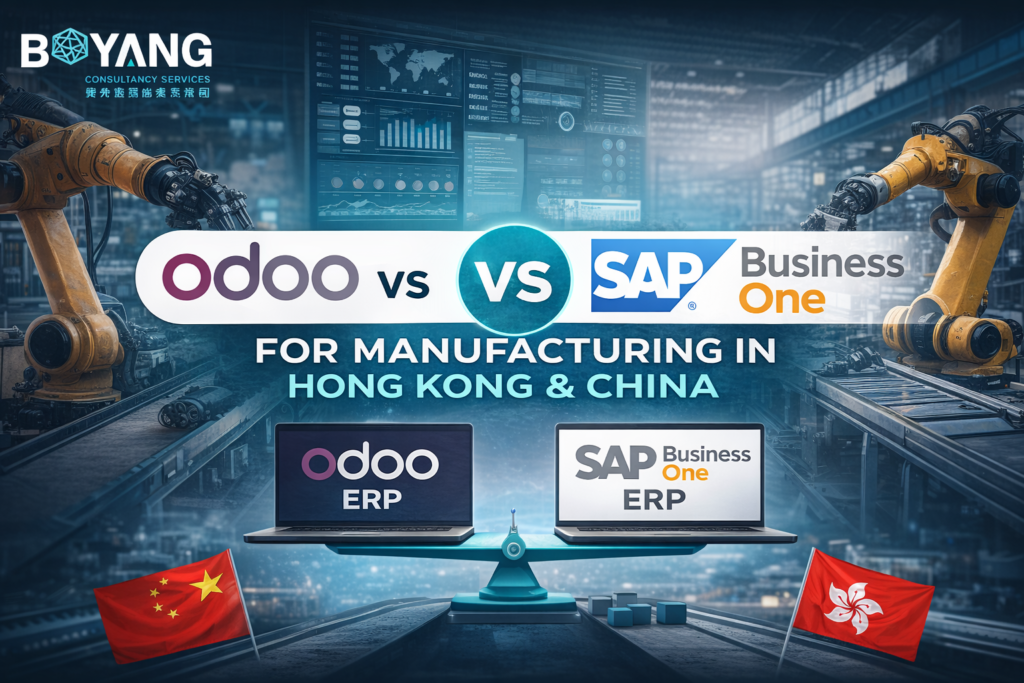
If you run a manufacturing business in Hong Kong, Shenzhen, or anywhere across the Greater Bay Area, you have likely asked this question: should we go with Odoo or SAP Business One?
Both are legitimate ERP platforms built for companies your size. Both handle production, inventory, financials, and procurement. But the similarities end there — and the differences matter enormously when you are dealing with cross-border operations, bilingual teams, China compliance requirements, and budget constraints that most SAP consultants ignore.
This guide is not a generic comparison you can find anywhere. It is written specifically for manufacturers operating between Hong Kong and China, based on real implementation experience across manufacturing, logistics, and high-tech companies in the region.
Boyang Consultancy Services is a certified Odoo partner with 20+ years of ERP implementation experience across manufacturing companies in Hong Kong, Shenzhen, Shanghai, and Kuala Lumpur.
1. Understanding the Two Products — You May Be Comparing the Wrong Things
Most comparison articles pit Odoo against SAP S/4HANA — a massive enterprise platform that starts at hundreds of thousands of dollars. That is the wrong comparison for 95% of manufacturers in Hong Kong and China.
SAP Business One (SAP B1) is SAP’s dedicated product for SMEs and mid-market companies. It is what most HK and China manufacturers actually get quoted when they approach SAP. It is vastly different from S/4HANA in scope, cost, and deployment.
| Odoo | SAP Business One | |
| Built for | SMEs to large enterprises | SMEs and mid-market (10–500 employees) |
| Deployment | Cloud, on-premise, hybrid | Cloud (SAP HANA Cloud) or on-premise |
| Licensing model | Modular subscription, per user | Named user license + annual maintenance |
| Open source | Yes (Community edition) | No — proprietary closed system |
| Customisation | High — Odoo Studio + Python modules | Limited — SAP SDK, requires certified developers |
| Partner ecosystem | 18 certified partners in Hong Kong | Fewer partners in HK/Greater Bay Area |
2. Real Implementation Costs in Hong Kong (2026 Estimates)
This is where most comparison articles fall short. Here are realistic cost ranges for a manufacturing company with 50–200 employees, based on current HK market rates:
| Cost element | Odoo ERP | SAP Business One |
| Software licence (annual) | HK$15,000–60,000 / year (modular, pay per app) | HK$80,000–180,000 / year (named users) |
| Implementation fee | HK$80,000–350,000 (depends on modules) | HK$250,000–800,000+ |
| Customisation | HK$500–900 / hour (Odoo developer) | HK$1,200–2,000 / hour (SAP B1 consultant) |
| Training | Included by most certified partners | HK$20,000–60,000 additional |
| Go-live timeline | 6 weeks – 6 months (phased rollout) | 4 – 12 months (typical HK mid-market) |
| Year 1 total (mid estimate) | ~HK$200,000–500,000 | ~HK$500,000–1,200,000+ |
Note: These are estimates for the Hong Kong market. China-side implementations may have different costs depending on localisation, server hosting requirements, and the partner’s presence in mainland China.
3. Manufacturing-Specific Features: Where Each System Wins
Generic ERP comparisons skip the features that actually matter for manufacturing. Here is how both platforms handle the key manufacturing workflows that HK and China manufacturers deal with daily:
Bill of Materials (BOM) and Production Orders
- Odoo: Multi-level BOM, phantom components, by-products, kit BOM — all included in the Manufacturing module. Can handle make-to-order, make-to-stock, and assemble-to-order without add-ons.
- SAP B1: Solid BOM management with production orders. However, complex multi-level BOM scenarios often require third-party add-ons, especially for electronics and high-tech manufacturers.
Shop Floor Control and Work Centres
- Odoo: Visual shop floor module (from Odoo 16+). Workers can scan operations from tablets. Work centres, capacity planning, and routing built in.
- SAP B1: Less intuitive shop floor management. Many manufacturers in HK add a separate MES (manufacturing execution system) alongside SAP B1, which increases total cost.
Inventory and Multi-Warehouse Management
- Odoo: Handles multi-warehouse operations across HK and mainland China within a single instance. Lot/serial number tracking, expiry dates, landed costs — all native.
- SAP B1: Strong inventory management, particularly for distribution and trading companies. Multi-warehouse is supported but cross-entity (HK entity + China WFOE) management can require the SAP Inter-company add-on.
Quality Control
- Odoo: Native quality module with control points, check types, and alerts. Can trigger holds directly from production orders.
- SAP B1: Basic quality management. Most manufacturers using SAP B1 for QC in China invest in a certified add-on like Boyum IT’s B1 Quality, which adds cost and a third-party dependency.
China-Specific: Golden Tax (增值税发票) Integration
This is the most important localisation question for manufacturers operating in mainland China. Both platforms support Chinese VAT invoicing (增值税专用发票), but through different paths:
- Odoo: China localisation is available and improving rapidly. Several certified partners including Boyang can implement Golden Tax System (金税系统) integration. Odoo’s open-source nature means the localisation can be customised to your specific tax situation.
- SAP B1: Has a dedicated China localisation package (SAP Business One, version for China) that includes Golden Tax integration, CIT, and VAT reporting. It is more mature and tested — though at a significantly higher cost.
For manufacturers operating entities on both sides of the border — a Hong Kong trading company plus a Shenzhen or Guangzhou manufacturing WFOE — Odoo’s multi-company setup handled in a single database is a genuine competitive advantage over SAP B1’s more complex inter-company configuration.
4. The Bilingual Requirement: A Bigger Deal Than You Think
Every ERP comparison guide published outside of Asia ignores this. For a manufacturer in Hong Kong with warehouse staff in Shenzhen and management reporting in English, the ERP needs to operate fluently across three languages simultaneously: English, Traditional Chinese (for HK), and Simplified Chinese (for mainland).
| Language feature | Odoo | SAP Business One |
| English interface | ✓ Full | ✓ Full |
| Simplified Chinese UI | ✓ Full native | ✓ Full (China version) |
| Traditional Chinese UI | ✓ Full native | ✓ Available (HK version) |
| Per-user language setting | ✓ Each user picks their language | Partial — per-installation, not per-user in all versions |
| Bilingual reports (EN + CN) | ✓ Configurable report templates | Requires custom development or add-on |
| Multilingual partner/customer data | ✓ Native — store names in both scripts | Limited — single name field per record |
5. When Should a HK/China Manufacturer Choose Odoo?
Based on our implementation experience across manufacturing clients in the region, Odoo is typically the stronger choice when:
- Your company has 20–500 employees and needs full ERP functionality without a six-figure software licence.
- You operate across Hong Kong and mainland China and need one system to manage both entities without heavy inter-company add-ons.
- You need to go live in under six months — whether due to a contract, audit requirement, or growth pressure.
- Your processes are non-standard and you need an ERP that can be customised to match how your factory actually runs, rather than forcing your team to change their workflow.
- You are currently on spreadsheets, legacy software, or an old ERP (Golden, SAP B1 older version) and need a clean migration path.
- You want a modern, mobile-friendly interface that your shop floor supervisors will actually use without weeks of training.
- You value transparency in pricing — Odoo’s modular billing means you know exactly what you are paying for.
6. When Should a HK/China Manufacturer Choose SAP Business One?
There are genuine scenarios where SAP Business One remains the right call:
- Your company is a subsidiary of a multinational that already runs SAP group-wide. Alignment with the parent’s system and reporting structure often outweighs any cost advantage.
- You operate in a heavily regulated industry (pharmaceutical, medical devices, food safety) where SAP’s compliance certifications and audit trails provide a measurable risk reduction.
- You have a dedicated IT team or budget for an IT team that can manage and maintain the SAP environment on an ongoing basis.
- Your business model has very high transaction volume (100,000+ orders per month) and you need SAP HANA’s in-memory database performance.
- Your CFO or board have a strong preference for SAP, and internal politics make switching a non-starter.
Honest assessment: For the typical Hong Kong SME manufacturer with 30–200 employees, a cross-border operation between HK and one or two mainland factories, and a budget of HK$200,000–600,000 for ERP, Odoo consistently delivers more value per dollar than SAP Business One in 2026.
7. Migration: Can You Move from SAP Business One to Odoo?
Yes — and it is more common than SAP would like you to know. Boyang has handled several migrations from SAP Business One to Odoo for manufacturers who found SAP’s maintenance costs and inflexibility unsustainable as they scaled.
The typical migration covers:
- Master data migration: customers, suppliers, products, BOMs, and routing from SAP B1 to Odoo.
- Historical transaction import: open purchase orders, sales orders, and current inventory levels at cutover date.
- Custom field mapping: identifying any SAP B1 customisations (user-defined fields, add-ons) and building equivalent functionality in Odoo.
- Parallel running period: typically 1–2 months where both systems run simultaneously to validate data integrity.
A clean migration for a mid-size manufacturer typically takes 3–5 months and costs HK$150,000–350,000 depending on data complexity.
8. How to Choose Your Odoo Partner in Hong Kong
Not every Odoo partner in Hong Kong has manufacturing experience. Choosing the wrong partner is the most common reason ERP projects fail — not the software itself. Here is what to check:
- Are they a certified Odoo partner? There are 18 certified Odoo partners in Hong Kong. Verify at odoo.com/partners before signing anything.
- Have they implemented Odoo for manufacturers specifically? Ask for case studies in manufacturing, logistics, or high-tech — not just retail or services.
- Do they have a team that speaks Mandarin and Cantonese? Cross-border projects require consultants who can work directly with your China-side team without translation delays.
- Do they have a China presence? Implementations that require Golden Tax integration, China-side hosting, or mainland warehouse management need a partner with actual people in China.
- What does post-go-live support look like? The real cost of ERP is not the implementation — it is the ongoing support. Confirm SLAs, support hours, and whether support is included or billed separately.
| Get a Free ERP Consultation
Boyang Consultancy Services is a certified Odoo partner with offices in Hong Kong, Shenzhen, Shanghai, and Kuala Lumpur. We have implemented Odoo ERP for 20+ manufacturing and logistics companies across the Greater Bay Area. Whether you are evaluating Odoo vs SAP Business One, planning a fresh ERP implementation, or considering migration from a legacy system — our certified consultants will give you an honest, no-pressure assessment of what makes sense for your business. Contact us: contact@boyangcs.com | +852 6858 6475 | boyangcs.com |
Final Thoughts
The Odoo vs SAP Business One question does not have a universal answer — but it does have a right answer for your specific business. The variables that matter most for Hong Kong and China manufacturers are cross-border entity management, bilingual operational requirements, manufacturing module depth, and total implementation cost within your actual budget.
For the majority of SME and mid-market manufacturers in the Greater Bay Area in 2026, Odoo delivers enterprise-grade manufacturing ERP at a fraction of the SAP Business One cost — with enough flexibility to adapt to the way your business actually operates.
If you are still unsure which direction to go, the best next step is a candid conversation with a certified Odoo partner who also knows the SAP landscape. That conversation should be free, and it should start with your business goals — not a sales pitch.