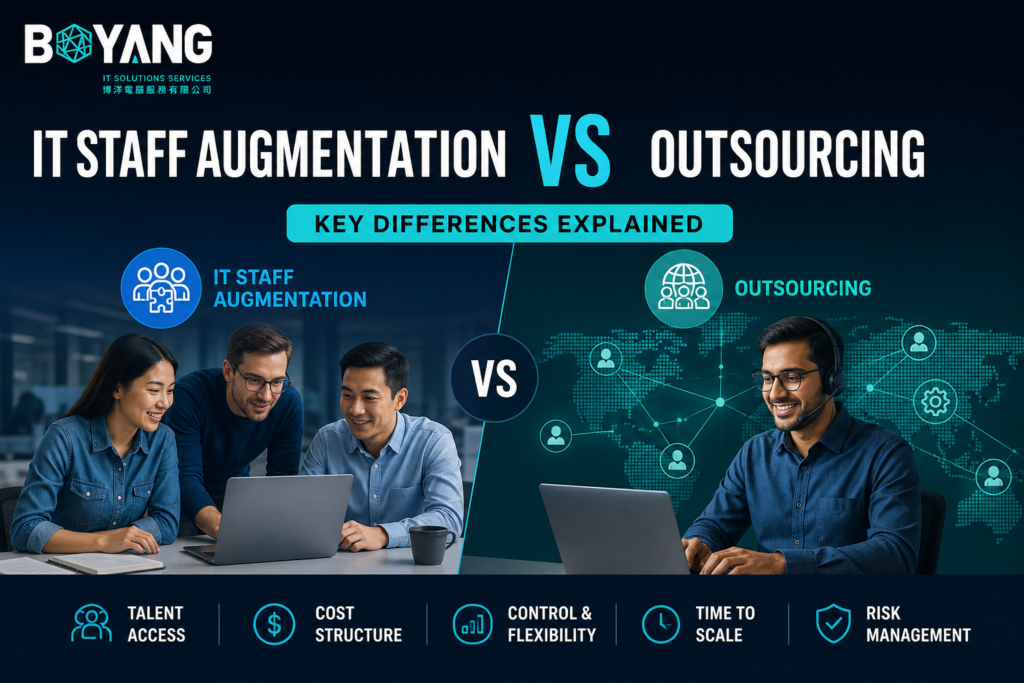
Both models help you access tech talent faster. But they work differently, cost differently, and suit different situations. Here is how to tell them apart and choose the right one.
What is IT staff augmentation?
IT staff augmentation means hiring external developers or specialists to work alongside your existing team. You stay in control of the work. The augmented staff follow your processes, use your tools, and report to your managers. You scale your team up or down based on project demand without long-term hiring commitments.
Companies use this model when they need specific skills quickly, want to maintain direct oversight, or have a temporary spike in workload. The external talent integrates with your in-house team rather than operating separately.
What is IT outsourcing?
IT outsourcing means handing a function or project to a third-party vendor. That vendor takes responsibility for delivery. They use their own processes, tools, and management structure. You define the outcome you want and the vendor figures out how to get there.
This model works well for ongoing operations like IT support, software maintenance, or entire product development cycles. You gain a dedicated team without managing them day to day.
Side-by-side comparison
| Factor | Staff Augmentation | Outsourcing |
|---|---|---|
| Control | You manage the team directly | Vendor manages their team |
| Responsibility | You own the outcome | Vendor owns the delivery |
| Integration | External staff joins your team | Vendor works independently |
| Flexibility | Scale quickly, short contracts | Usually longer agreements |
| Cost model | Pay per resource, per hour or month | Pay per project or fixed fee |
| Best for | Skill gaps, project surges | Full function delegation |
| Knowledge retention | Stays with your team | Stays with the vendor |
| Communication overhead | Lower, direct integration | Higher, vendor coordination needed |
The key differences that matter most
Staff Augmentation
- You keep full oversight of day-to-day work
- External talent adopts your culture and workflows
- Easier to course-correct in real time
- Knowledge stays inside your organization
- Scales without long-term hiring risk
Outsourcing
- Vendor handles hiring, training, management
- Frees your team from operational load
- Predictable cost with fixed contracts
- Access to broader vendor expertise
- Suits long-term, ongoing functions
When to choose staff augmentation
Staff augmentation fits when your project needs specific technical skills for a defined period. It also works when you want external talent to work within your existing development process without disrupting your workflow.
| Good fit scenarios | Not ideal when |
|---|---|
| You have a temporary skill gap | You lack internal management bandwidth |
| Project deadlines require more developers now | You need an entire function handled end-to-end |
| You want to keep IP and code ownership | Long-term operational work needs constant attention |
| Your in-house team leads the project | Your team has no clear technical direction |
When to choose outsourcing
Outsourcing fits when you need a vendor to own an entire function or project outcome. It works best when your internal team cannot or should not manage the technical work directly.
| Good fit scenarios | Not ideal when |
|---|---|
| IT support or helpdesk operations | You need tight control over the process |
| Full product builds with vendor accountability | The project is early-stage and evolving fast |
| Cost reduction through offshore teams | Collaboration with your in-house team is critical |
| Recurring maintenance and operations | You need to retain technical knowledge internally |
Cost considerations
Staff augmentation billing is typically hourly or monthly per resource. You pay for the talent you use and stop when you no longer need them. This gives you flexibility but requires active management to avoid scope drift.
Outsourcing often uses fixed-price or retainer contracts. Costs are more predictable upfront, but scope changes lead to renegotiations. Hidden costs in outsourcing include vendor coordination time, quality reviews, and dependency on third-party timelines.
Neither model is universally cheaper. The right choice depends on how long you need the resources, how much management capacity you have, and how clearly defined your requirements are.
Risk and accountability
With staff augmentation, delivery risk stays with you. If timelines slip or quality drops, your leadership is accountable. That is not a drawback if your team has strong technical direction. It means you stay in control of the outcome.
With outsourcing, the vendor takes on delivery risk contractually. But vendor dependency creates its own risks. If a vendor underperforms or exits the contract, your operations can stall. You also have less visibility into how the work is done.
Which model is right for you?
If you have a strong internal team and need specific skills fast, staff augmentation is the better fit. If you want to delegate an entire function and focus your team elsewhere, outsourcing makes more sense. Many companies use both at different stages. The decision comes down to how much control you need and how much management load your team handles well.