Hiring the wrong Odoo functional consultant costs you more than the fee. It costs you months of delays, a messy chart of accounts, and a team who quietly goes back to spreadsheets.
Most buyers screen for industry experience and demo skills. Those matter. They are also the easiest things to fake in a sales call. The harder question is whether the person sitting across from you understands how Odoo works underneath the buttons.
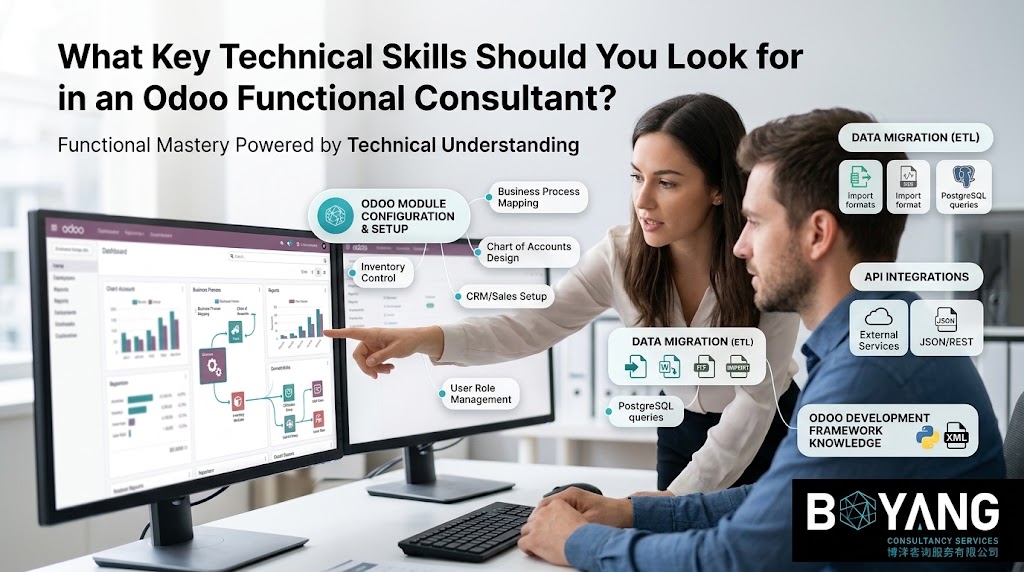
An Odoo functional consultant sits between your business process and the software. They do not write full custom modules. They still need enough technical depth to know what Odoo does natively, what needs configuration, what needs code, and what you should never attempt at all. This guide covers the technical skills worth testing before you sign anything.
What an Odoo Functional Consultant Does Day to Day
The job title confuses people. A functional consultant is not a project manager with ERP vocabulary, and they are not a developer.
Their work looks like this:
- Map your current business process and find the gaps
- Match each process step to a standard Odoo feature
- Configure modules, workflows, approval rules and user permissions
- Import and clean your existing data
- Train your staff and run user acceptance testing
- Write clear specifications when a developer is needed
- Support you after go live
Notice how much of this touches the system directly. A consultant who hands everything to a developer slows your project down and inflates your budget. One with real product depth solves eighty percent of requirements with configuration alone.
Why Technical Depth Matters in a Functional Role
Odoo ships with thousands of settings. The difference between a three month rollout and an eight month rollout is usually the consultant’s ability to say no to customisation.
A weak consultant hears a requirement and quotes development hours. A strong one knows a setting already exists in Inventory, or an automated action handles it in ten minutes. Every line of custom code you avoid makes your next version upgrade cheaper and safer.
Technical depth also protects you from bad promises. When someone tells you Odoo handles something natively and it does not, you find out during go live week. By then you have paid for the licence, the training and the staff time.
Core Technical Skills to Look For
1. Deep Knowledge of the Standard Odoo Modules
Start here. Your consultant should know how Sales, Purchase, Inventory, Manufacturing, Accounting, CRM, Project and HR behave on their own and how they behave together.
Module knowledge means more than clicking through menus. Ask how a confirmed sales order creates a delivery order, how the delivery validates a stock move, and how the stock move generates an accounting entry under Anglo Saxon accounting. A consultant who answers the full chain clearly has done real implementations. One who talks in features and benefits has done demos.
Pay attention to dependency awareness too. Enabling multi step routes in Inventory changes how Manufacturing behaves. Turning on analytic accounting changes what Sales and Timesheets produce. Good consultants warn you before flipping those switches.
2. Understanding of the Odoo Data Model
Odoo is a database with a friendly interface. Your consultant needs to understand the structure underneath.
Look for working knowledge of:
- Models and fields, and how developer mode exposes technical names
- One to many, many to one and many to many relationships
- External IDs and how they keep imported records linked
- The difference between stored and computed fields
- How ORM methods like create, write and unlink affect records
You do not need a database administrator. You need someone who understands why a field shows blank after an import, or why deleting a product breaks historical invoices. This knowledge separates consultants who fix problems from consultants who escalate them.
3. Configuration Skill Without Writing Code
Odoo gives you a large toolkit before any development starts. Test whether your candidate uses it.
Ask about:
- Odoo Studio for adding fields, editing views and building simple approval flows
- Automated actions and scheduled actions for background rules
- Server actions and basic Python snippets inside the interface
- Email templates and QWeb template editing
- Domain filters and dynamic record selection
A consultant who builds an approval workflow in Studio during a scoping call is worth more than one who quotes forty development hours for the same outcome. Ask for a live example. Watch how quickly they move through developer mode.
4. Data Migration and Import Ability
Data migration sinks more Odoo projects than any other task. Old systems hold years of customers, products, stock balances, open invoices and partial payments. All of it needs to land in the right place.
Your consultant should know how to:
- Prepare clean CSV and XLSX import templates for each model
- Use external IDs so relationships survive the import
- Sequence imports correctly, starting with partners and products before transactions
- Import opening balances without breaking the general ledger
- Handle multi currency, multi company and multi warehouse data
- Roll back a failed import without corrupting the database
Ask how they handle partially paid invoices from a legacy system. The answer tells you fast whether they have migrated real accounting data or only test records.
5. Reporting and Document Customisation
Every business wants their own invoice layout, delivery note and management report. This work falls to the functional consultant more often than people expect.
Useful skills here include QWeb report editing, list and pivot view configuration, graph views, and building custom dashboards. Add spreadsheet knowledge inside Odoo, since finance teams live in pivot tables.
Ask whether they know how to add a field to a printed invoice without a developer. Ask how they would build a monthly gross margin report by product category. Both questions surface real ability in minutes.
6. Access Rights, Security and Multi Company Setup
Permissions look boring until your warehouse team edits pricing or a branch manager sees group financials.
Look for clear understanding of user groups, access control lists, record rules, and the difference between global and group specific rules. Multi company work adds another layer, with shared records, inter company transactions and company specific chart of accounts.
Test this with a scenario. Tell them one sales team should see only their own quotations while managers see everything. A capable consultant explains record rules on the spot.
7. API and Integration Knowledge
Odoo rarely lives alone. It connects to ecommerce platforms, payment gateways, shipping providers, government tax portals and legacy systems.
Your consultant does not need to build the integration. They need to scope it. Look for familiarity with the XML RPC and JSON RPC endpoints, REST connectors, webhook behaviour, and middleware tools such as n8n or Zapier. Ask how they would sync stock levels between Odoo and a Shopify store, and how they would prevent duplicate orders during a sync failure.
Consultants who have handled integrations think about error handling first. Consultants who have not think about the happy path only.
8. Accounting and Local Fiscal Knowledge
Accounting is where implementations get audited. Your consultant needs product knowledge plus local compliance knowledge.
Check for:
- Chart of accounts setup and fiscal position configuration
- Tax mapping for local and cross border sales
- Anglo Saxon versus Continental accounting and the effect on stock valuation
- Bank reconciliation and statement import rules
- Localisation modules for your country, along with any e invoicing requirement
If you operate in Hong Kong, Malaysia or the Greater Bay Area, ask directly about regional localisation packages and reporting formats. A consultant familiar with your jurisdiction saves your finance team weeks of rework.
9. Version Awareness and Upgrade Experience
Odoo releases a new version every year. Features move, deprecate and change behaviour between releases.
Ask which versions they have implemented and which migrations they have run. A consultant who has upgraded a live database from Odoo 16 to Odoo 18 understands why heavy customisation hurts. They also know how the OpenUpgrade path works and where custom modules break.
This skill has direct budget impact. Your upgrade cost in three years depends on decisions made during this implementation.
10. Deployment and Hosting Basics
You have three hosting paths with Odoo. Online SaaS, Odoo.sh, and self hosted on premise or cloud. Each one limits what your consultant is able to install.
Look for practical understanding of staging branches on Odoo.sh, backup and restore routines, database duplication for testing, and basic log reading. A consultant who knows why a module refuses to install on Odoo Online saves you from a hosting choice you regret later.
11. Requirement Gathering and Documentation
This skill looks soft. It is technical work.
A strong consultant produces process maps, gap analysis documents, functional specifications and test scripts. Their specifications give developers enough detail to build without guessing. Their test scripts let your staff validate the system before go live.
Ask to see a redacted specification document from a past project. The quality of the writing predicts the quality of your build.
12. Testing and User Acceptance Support
Someone needs to break the system before your customers do. Your consultant should design test cases, run them in a staging database, log defects clearly and retest fixes.
Ask how they structure user acceptance testing. Look for named test owners, written scenarios and a sign off step. Vague answers here lead to go live weekends nobody enjoys.
Functional Consultant Versus Technical Consultant
Buyers often hire the wrong profile. This table shows where each role fits.
| Area | Functional Consultant | Technical Consultant |
|---|---|---|
| Main focus | Business process and configuration | Code, modules and architecture |
| Typical tools | Studio, automated actions, imports, reports | Python, XML, JavaScript, PostgreSQL |
| Handles requirements | Gathers and documents them | Builds against the documented spec |
| Data migration | Prepares and runs imports | Writes migration scripts for complex cases |
| Customisation | Configures within standard limits | Develops custom modules |
| Training | Trains end users | Supports the functional team |
Small and mid sized rollouts often need one strong functional consultant and part time developer support. Complex manufacturing or multi entity projects need both roles full time.
How to Test These Skills Before You Hire
Interviews reward talkers. Practical tests reward doers. Use both.
Try this sequence:
- Give a short written scenario from your own business and ask for a configuration approach in one page.
- Run a live screen share session. Ask them to build a small workflow in a demo database while you watch.
- Ask for two client references with similar scope to yours, then call them.
- Ask what they would refuse to customise and why. Strong answers show product discipline.
- Ask about a project which went badly and what they changed afterwards.
Time box the exercise. Two hours of practical assessment tells you more than five interviews.
Warning Signs Worth Noticing
- Every requirement turns into a development quote
- No questions about your current process before proposing a solution
- Vague answers on accounting setup or stock valuation
- No experience with your Odoo version or your industry
- No written scope, only verbal agreement
- Promises of a full rollout in unrealistic timelines
One more sign. Watch how they handle disagreement. A consultant who agrees with everything you say during scoping will agree with everything during the build, including choices which hurt you later.
Your Hiring Checklist
Print this and score each candidate from one to five.
- Standard module knowledge across your required apps
- Understanding of the Odoo data model and external IDs
- Practical Studio and automated action skill
- Proven data migration experience with financial data
- Report and document customisation ability
- Access rights and record rule knowledge
- Integration scoping experience
- Accounting and local compliance depth
- Version upgrade experience
- Hosting and deployment awareness
- Clear documentation samples
- Structured testing approach
Anyone scoring below three on migration, accounting or access rights needs support from a second consultant.
Frequently Asked Questions
Does an Odoo functional consultant need to know Python?
Not at a developer level. Reading Python helps them understand server actions, automated rules and error messages. Writing full modules belongs to a technical consultant.
How much Odoo experience should a functional consultant have?
Look for at least three completed implementations end to end, with go live and post launch support included. Demo experience alone does not prepare someone for data migration or accounting setup.
Should I hire a freelancer or an Odoo partner?
Freelancers work well for single module rollouts and smaller budgets. Certified Odoo partners suit multi department implementations, since they bring developers, accountants and support staff together. Check availability for post go live support either way.
What certifications matter for Odoo consultants?
Odoo runs official certification exams for each major version. Certification proves product knowledge. It does not prove implementation judgement, so treat it as one input rather than the deciding factor.
How long does a typical Odoo implementation take?
Single department rollouts often run six to twelve weeks. Multi department or multi company projects run four to nine months. Data quality and decision speed on your side affect the timeline more than the software does.
What is the biggest risk in an Odoo project?
Over customisation. Every custom module raises your upgrade cost and your bug surface. A skilled functional consultant reduces customisation by knowing standard features deeply.
Final Thoughts
Hire for depth, not for polish. The best Odoo functional consultant on your shortlist is usually the one asking uncomfortable questions about your process, pushing back on custom requests, and showing you a working configuration instead of a slide.
Test the twelve skills above with real scenarios from your business. Score them honestly. The two hours you spend assessing a candidate protects the six months and the budget you are about to commit.