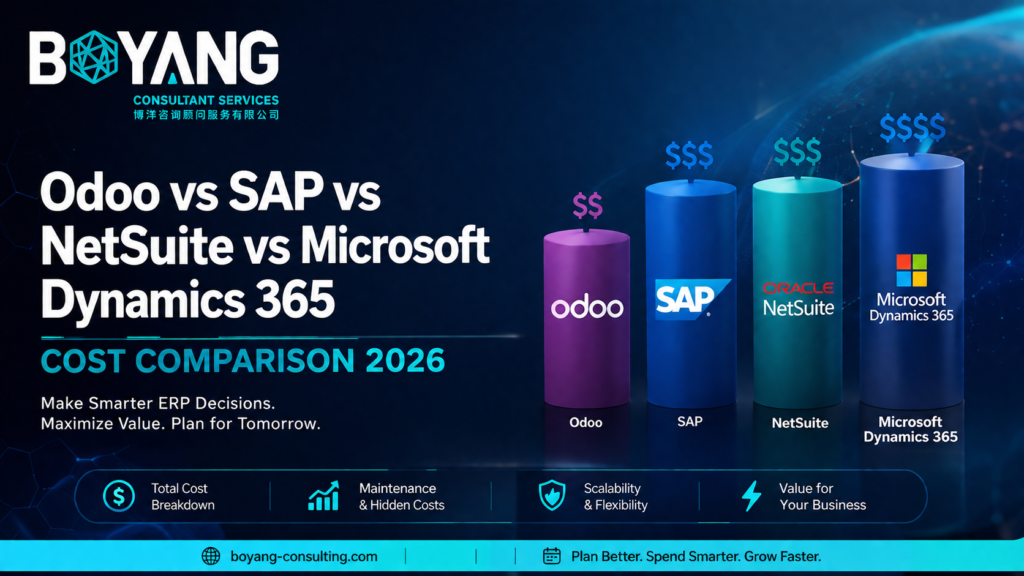
Choosing an ERP system comes down to one question most vendors avoid answering directly: what will it cost you, all in, over three years. This guide breaks down real 2026 pricing for Odoo, SAP Business One, Oracle NetSuite, and Microsoft Dynamics 365 Business Central, so you can compare them on equal terms before you talk to a sales rep.
Every vendor here uses a different pricing model. Odoo charges per user for a full app suite. SAP splits between cloud subscriptions and one-time licenses. NetSuite adds a base platform fee on top of per-user costs. Microsoft prices by license tier. This guide converts all four into the same numbers, so you see what a 25-user company actually pays.
Quick Pricing Comparison
| ERP System | Monthly Cost Per User | Setup Cost | Best Fit |
|---|---|---|---|
| Odoo | $24 to $76 (region dependent) | $5,000 to $45,000 | Small businesses and mid-market companies on a budget |
| SAP Business One | $80 to $150 | $30,000 to $120,000 | Small and mid-sized manufacturers already in the SAP ecosystem |
| Oracle NetSuite | $999 base plus $99 to $199 per user | $25,000 to $500,000+ | Fast-growing mid-market companies with complex operations |
| Microsoft Dynamics 365 Business Central | $8 to $110 (tier dependent) | $25,000 to $150,000 | Companies already running Microsoft 365 and Azure |
These figures come from published vendor pricing and independent implementation benchmarks gathered in 2026. Your actual quote depends on region, user count, contract length, and how much customization you need.
Odoo Pricing Breakdown
Odoo publishes its pricing directly, which sets it apart from the other three vendors on this list. There are three tiers.
One App Free gives you a single application, such as CRM or Invoicing, with unlimited users, at no cost, forever. Hosting and upgrades for that one app are included.
Standard unlocks the full suite of Odoo apps, including Accounting, Sales, Inventory, and HR, on Odoo’s cloud hosting. In the US, this runs $24 per user per month with the 12 month introductory discount, rising to $31.90 after that. In lower cost regions such as the Middle East or parts of Asia, the same plan runs closer to $9 to $14 per user per month.
Custom adds Odoo Studio for building your own modules, multi-company support, external API access, and the choice of on-premise or Odoo.sh hosting. In the US, this starts at $49 per user per month with the discount, rising to $61 to $76.20 after the first year.
Odoo does not charge separately for individual apps. One subscription covers accounting, CRM, inventory, HR, manufacturing, project management, and dozens of other modules. This is the main reason Odoo comes in cheaper than the other three systems on this list at the license level.
Implementation is where Odoo costs diverge most by project size. A small team with a straightforward setup typically spends $5,000 to $15,000 on implementation. A mid-sized company with custom workflows and integrations spends $15,000 to $45,000 or more.
SAP Business One Pricing Breakdown
SAP Business One is built for small and mid-sized manufacturers, not for the huge enterprises that run SAP S/4HANA. It runs on a separate codebase and is sold only through certified partners, which is why SAP publishes no public price list.
Cloud subscription pricing runs $80 to $150 per user per month for most deployments, though quotes from $95 up to $250 per user per month appear across the market depending on your partner and license tier. SAP splits users into three tiers: Starter (up to 5 users), Limited User, and Professional User. Professional users, who get full read and write access, sit at the top of that range.
On-premise perpetual licenses cost $3,000 to $5,500 per user as a one-time fee. On top of that, SAP charges annual maintenance of 18 to 20 percent of the original license value, every year, for as long as you want updates, patches, and support. On a $21,000 license purchase, that works out to roughly $4,000 a year, indefinitely.
Implementation for SAP Business One typically runs $30,000 to $120,000 for a standard deployment, and higher for complex multi-entity or manufacturing setups. Most buyers see 15 to 25 percent discounts off the initial quote by negotiating on committed user count, contract length, or timing the deal around SAP’s quarter end.
Oracle NetSuite Pricing Breakdown
NetSuite uses a three-part pricing model: a base platform fee, per-user licenses, and optional modules. Oracle does not publish official prices, so every quote is negotiated.
The base platform fee typically runs $999 to $5,000 per month, depending on edition and service tier. On top of that, full users, meaning employees who need broad access to enter and manage transactions, cost $99 to $199 per user per month. Lower cost tiers exist for limited access, such as Employee Self-Service licenses, which run closer to $10 to $25 per user per month.
A small business with 10 users and core ERP functionality typically pays $3,000 to $5,000 per month in total license fees. A mid-market company with 50 users running ERP, CRM, and ecommerce together typically pays $10,000 to $25,000 per month.
Implementation costs vary widely based on complexity, from $25,000 for a simple deployment up to $500,000 or more for a large, heavily customized rollout. Consulting hours for implementation run $150 to $350 per hour. Signing a three year contract typically earns a 15 to 25 percent discount over year to year pricing, and five year contracts can push savings past 30 percent.
Microsoft Dynamics 365 Business Central Pricing Breakdown
Business Central is the most transparent pricing model on this list after Odoo. Microsoft publishes its rates directly, with three license tiers.
Essentials covers core ERP functions: general ledger, accounts payable and receivable, bank reconciliation, purchasing, inventory, and basic CRM. It runs $70 to $80 per user per month, paid annually.
Premium includes everything in Essentials plus manufacturing functionality: production orders, bills of materials, capacity planning, and service management. It runs $110 per user per month.
Team Members is a light license for people who only need to view data, approve expenses, or handle simple transactions. It runs $8 per user per month, which makes it a practical way to give visibility to managers and executives without paying full license fees for every seat.
Microsoft Copilot AI features are included in both Essentials and Premium at no extra charge, which is notable given competitors often charge separately for AI capabilities.
Implementation for Business Central typically runs $25,000 to $150,000 depending on company size and complexity, with most standard mid-market deployments landing in the $35,000 to $60,000 range. Go live timelines usually run 8 to 16 weeks.
Three Year Cost Comparison for a 25 User Company
The table below models a realistic scenario for a 25-user company choosing a mid-tier plan from each vendor, over a three year period. These are illustrative estimates built from the pricing above, not vendor quotes, and your actual cost depends heavily on region, negotiation, and implementation scope.
| ERP System | License Cost (3 Years) | Implementation | Estimated 3 Year Total |
|---|---|---|---|
| Odoo Standard | $27,900 | $15,000 | $42,900 |
| Odoo Custom | $54,900 | $30,000 | $84,900 |
| SAP Business One (cloud) | $103,500 | $50,000 | $153,500 |
| Oracle NetSuite | $189,000 | $75,000 | $264,000 |
| Dynamics 365 Business Central Essentials | $72,000 | $60,000 | $132,000 |
| Dynamics 365 Business Central Premium | $99,000 | $60,000 | $159,000 |
Odoo comes out lowest on both license fees and typical implementation cost. NetSuite comes out highest, largely because of the base platform fee that sits on top of per-user pricing regardless of how many people use the system. SAP Business One and Dynamics 365 Business Central land in the middle, with SAP’s cost driven up by higher per-user rates and Dynamics driven up by a heavier implementation process.
Hidden Costs to Watch For
License price is rarely the full story with any of these four systems. A few costs show up after the contract is signed, not before.
Annual maintenance fees apply to on-premise SAP licenses at 18 to 20 percent of the license value every year, whether or not you use new features. Cloud subscriptions from Odoo, NetSuite, and Microsoft avoid this by bundling maintenance into the monthly fee.
Module and add-on costs stack up fast with NetSuite and SAP, where advanced manufacturing, warehouse management, or industry-specific functionality often carry separate fees. Odoo bundles nearly every app into its Standard and Custom plans at no extra charge.
Custom development and integrations add cost regardless of vendor, but the gap widens with SAP and NetSuite, where finding certified developers costs more per hour than the broader Odoo partner network.
Multi-year price increases matter too. NetSuite raised its full-user license price roughly 30 percent in a recent renewal cycle, and Microsoft has adjusted Business Central pricing more than once in the past two years. Locking in a multi-year contract early protects you from these increases, but reduces your flexibility to switch systems later.
Which ERP Fits Which Business
Odoo fits small businesses and mid-market companies that want broad functionality, from accounting to manufacturing to ecommerce, without paying separately for each module. It also fits companies that expect to grow and want the flexibility to add apps as needed without renegotiating a contract.
SAP Business One fits small and mid-sized manufacturers, particularly those already working with SAP-certified partners or planning an eventual move to SAP S/4HANA as they scale past 200 users.
NetSuite fits fast-growing mid-market companies with complex, multi-entity operations, especially those in ecommerce, wholesale distribution, or software, where NetSuite’s maturity in these verticals often outweighs the higher price.
Dynamics 365 Business Central fits companies already invested in the Microsoft ecosystem, running Microsoft 365, Teams, and Azure, where the native integration with tools employees already use cuts down on training time and connector costs.
Frequently Asked Questions
Is Odoo cheaper than SAP Business One?
Yes, in nearly every scenario. Odoo’s Standard plan runs $24 to $32 per user per month against SAP Business One’s $80 to $150 per user per month for a comparable cloud subscription. The gap holds at the implementation level too, with Odoo projects typically costing less than half of a comparable SAP Business One rollout.
Why does NetSuite cost more than the other three systems?
NetSuite charges a base platform fee of $999 to $5,000 per month on top of per-user pricing. No other vendor on this list charges a separate platform fee, so NetSuite’s total cost stays higher even when the per-user rate looks similar to SAP.
Does Microsoft Dynamics 365 Business Central include CRM?
Yes. The Essentials tier includes basic CRM functionality such as contact and opportunity management. Companies needing a dedicated CRM system typically add a Dynamics 365 Sales license on top, which runs $105 per user per month at the Enterprise tier.
Can you negotiate ERP pricing?
Yes, with all four vendors. SAP, NetSuite, and Microsoft partners routinely offer 15 to 30 percent discounts for multi-year contracts or larger committed user counts. Odoo’s published pricing includes a built in first-year discount, and further reductions are available through certified partners for larger deployments.
What is the real total cost of ERP ownership, beyond the license?
License fees usually cover 30 to 50 percent of total first-year cost. The rest goes to implementation, data migration, training, and any custom development. This holds true across all four systems, though the ratio shifts: Odoo implementations tend to run lower in absolute dollars, while SAP and NetSuite implementations often exceed the first year of license fees combined.
Final Thoughts
Price alone should not decide which ERP system you pick, but it narrows the field fast. Odoo delivers the lowest total cost of ownership for most small and mid-market companies, without giving up core functionality across accounting, sales, inventory, and manufacturing. SAP Business One and NetSuite justify their higher price for companies with complex, industry-specific needs or plans to scale into enterprise territory. Dynamics 365 Business Central earns its spot for companies already committed to the Microsoft stack.
Whichever system you choose, model the three year total cost before signing, not just the monthly license fee. That single step catches most of the budget surprises companies run into six months after go live.